
See how we produce optimal AI solutions for our clients.
Jackalope automates transforming complex medical data into standardized formats of OMOP CDM and SNOMED Clinical Terms (CT). This enables healthcare providers, practitioners, and scientists to effectively use real-world evidence (RWE) in healthcare for research and delivering enhanced patient care.
Published: April 29, 2024Our client was a U.S.-based, multi-institutional healthcare research initiative developing an AI-ready clinical data ecosystem for critical-care research. The initiative brought together several institutional data sources with differences in clinical workflows, source systems, coding practices, data availability, and OMOP ETL implementations. The client needed a systematic way to translate complex clinical research questions into reproducible computable phenotypes that could support cohort discovery, population characterization, outcome definition, and downstream analytical and machine-learning workflows. The project focused on structured electronic health record data represented primarily through the OMOP Condition, Procedure, Measurement, Observation, Device, Drug, Specimen and Visit domains. To preserve confidentiality, the organization and individual clinical use cases are not disclosed.
Published: August 6, 2026
Our client, a U.S. health insurer collaborating with multiple hospital systems, aimed to aggregate and harmonize anonymized claims and clinical data in the PCORnet Common Data Model (CDM) to support large-scale outcomes research and operational analytics. The incoming medical and billing feeds came from heterogeneous hospital and payer systems with inconsistent schemas, variable data quality, and no unified governance. The client asked SciForce to design and implement a sustainable, cloud-native ETL/ELT pipeline on Snowflake that would: 1) Continuously integrate raw source feeds into a centralized Snowflake data platform; 2) Transform them into a PCORnet-conformant CDM with strong data quality guarantees; 3) Enable near real-time analytics for patient demand forecasting, capacity planning, and revenue cycle optimization.
Published: December 3, 2025
The client was a residential care facility for elderly patients who were at risk of falling, relying on wearable sensor fall detection for assisted living facilities to reduce incidents and response time. Each resident wore a small motion-tracking device as part of a wearable health monitoring setup that measured their movements in three directions. Their rooms were also equipped with AI in assisted living facilities that monitored temperature, humidity, light, noise levels, and whether someone was in or out of bed. The goal was to build an AI fall detection system that could automatically detect when someone had fallen and notify staff quickly. The team focused on understanding how movement patterns could indicate a fall and explored how room data could help add context in the future.
Published: September 11, 2025
Our client is a university hospital based in Germany, aimed to enhance cross-institutional standardized healthcare data exchange through structured health data pipelines. Multiple institutions involved in observational research sought integrating observational research data into clinical systems via FHIR, including risk models and disease prevalence metrics, into operational clinical workflows. To support this goal, the client required a conversion pipeline from OMOP CDM (used in research analytics) to HL7 FHIR (used in clinical applications) to enable real-time data AI for healthcare data interoperability.
Published: August 28, 2025
The client is a professional healthcare technology provider whose platform is used by multiple medical institutions to support clinical medical data interoperability. The project focused on enabling medical semantic search using LLMs and vector databases, allowing healthcare teams to structured clinical data extraction from free-text input. To achieve this, the platform integrates large language models for real-time query normalization and a locally deployed Quadrant vector database for high-performance concept retrieval. The solution was designed to deliver accurate concept mapping at scale, while aligning with MLOps and DevOps best practices to ensure reproducibility, modularity, and operational stability across environments.
Published: August 11, 2025
The client was a public-sector healthcare organization focused on automated epidemiological monitoring and preparedness. They needed an automated disease spread forecasting system to predict the spread of illness across administrative districts based on hospital-reported case data. Key priorities included low-maintenance deployment, seamless integration with existing health data pipelines, and the ability to scale across geographic units. Their use case demanded robust AI in healthcare infrastructure to ensure consistent model retraining, evaluation, and deployment, minimizing manual oversight while maintaining high model performance.
Published: July 14, 2025
Our client develops standardized medical vocabularies that unify data from different sources, ensuring consistency and interoperability, to support observational studies and generate real-world evidence (RWE) analytics. Their work helps researchers, data scientists, and healthcare professionals conduct data-driven healthcare research, integrating and analyzing medical information using established standards like SNOMED CT, LOINC, and RxNorm. By structuring and maintaining the unified medical dictionaries, they support large-scale research, improve data accessibility, and help healthcare providers to make decisions based on up-to-date evidence. Their approach allows global medical collaboration and applying data-driven insights in medical practice and research.
Published: March 19, 2025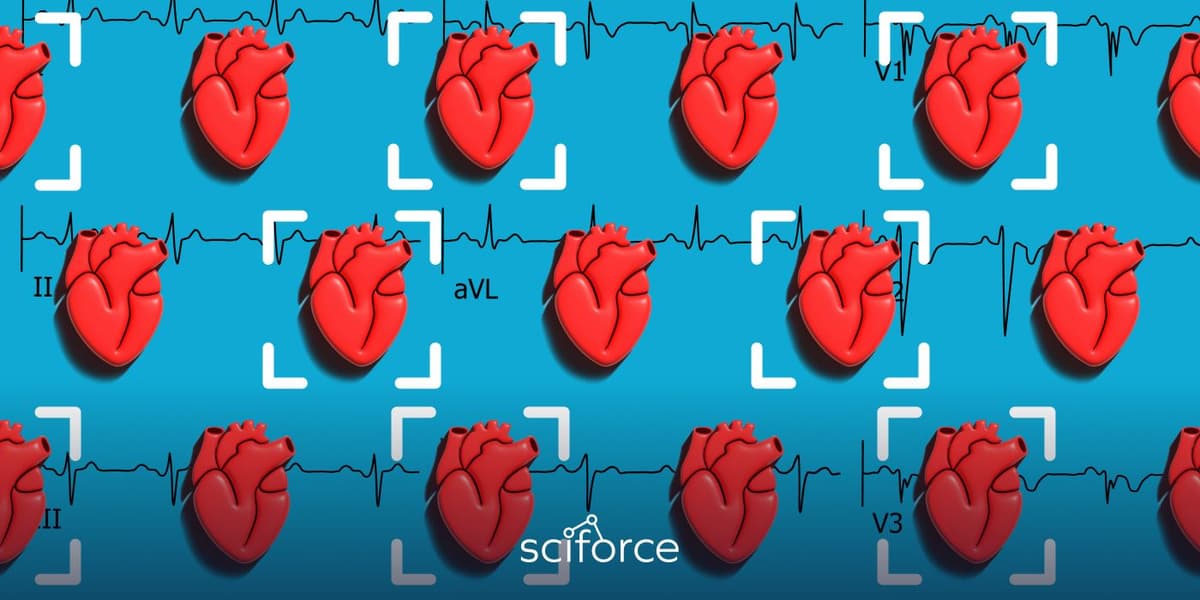
Cardiovascular diseases (CVDs) are a major global health concern, accounting for a significant number of deaths each year and being a leading cause of mortality worldwide. Accurate and timely diagnosis of CVDs is crucial for effective treatment and improved patient outcomes. The gold standard used for screening and diagnosing CVDs is Electrocardiography (ECG). However, accurately interpreting ECG results can be challenging for healthcare professionals. In this case study, we explored the implementation of Machine Learning (ML) for ECG recognition to enhance diagnostic accuracy and enable timely interventions.
Published: January 22, 2025
A private research organization focused on evaluating the safety and effectiveness of medications. Their goal is to use advanced medical data analytics and data harmonization in healthcare to support healthcare decisions and meet regulatory standards. For this project, they aimed to assess the safety of hydroxychloroquine, used alone or with azithromycin, for treating rheumatoid arthritis. The study focused on identifying short-term side effects and long-term risks, especially related to heart health and the use of multiple medications together. The client needed a data-driven approach, similar to methods used in federated healthcare data platforms, to fill gaps in existing evidence by combining different clinical data sources and applying patient similarity networks for clinical decision-making to identify patient groups with similar characteristics and address factors that could affect treatment outcomes.
Published: January 21, 2025