• Services
    LLM
    AI & ML
    Digital Healthcare
    Data Science
    DevOps
  • Products
    Jackalope
    EyeAI
  • Industries
    Healthcare
    Agriculture
    EdTech / LMS
    Retail / E-commerce
    Manufacturing
  • Resources
    Blog
    Case Studies
    Expert Guides
  • Company
    About us
    Careers
  • Contact us
logo
Services
LLMAI & MLDigital HealthcareData ScienceDevOps
Industries
HealthcareAgricultureEdTech / LMSRetail / E-commerceManufacturing
Case StudiesAbout UsBlogCareers
Our contacts
+380(66)54-32-579
sales@sciforce.tech

Get monthly digest of innovations

This site is protected by reCAPTCHA and the Google Privacy Policy and Terms of Service apply.
Social Media:
Privacy Policy © 2026 Sciforce
5.0
ML-Driven ECG Interpretation cover

ML-Driven ECG Interpretation for Decision-Making

Published: January 22, 2025
# Healthcare
# AI / ML
# Data Science
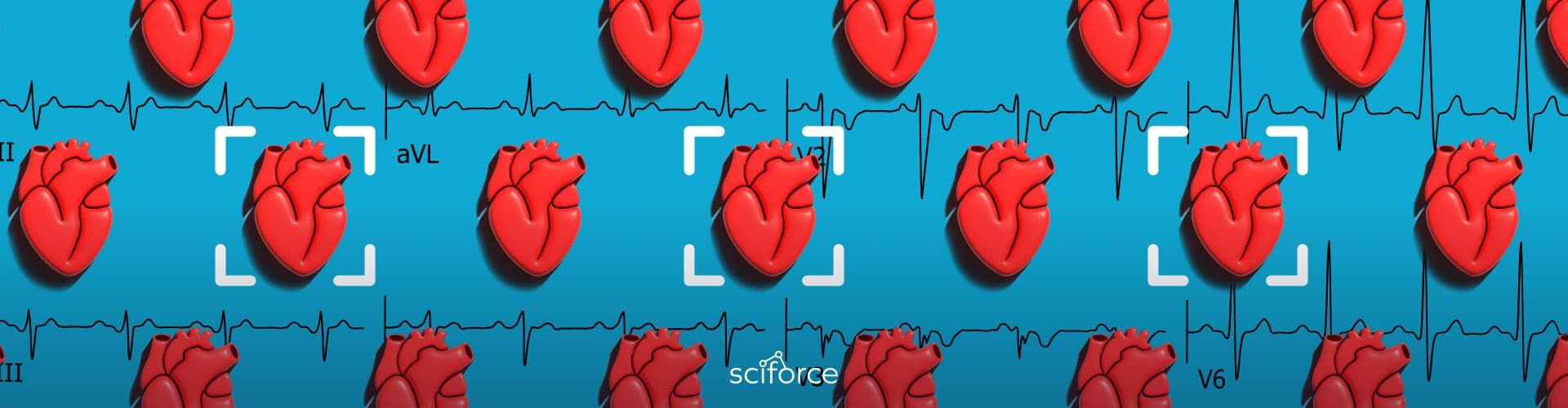
Cardiovascular diseases (CVDs) are a major global health concern, accounting for a significant number of deaths each year and being a leading cause of mortality worldwide. Accurate and timely diagnosis of CVDs is crucial for effective treatment and improved patient outcomes. The gold standard used for screening and diagnosing CVDs is Electrocardiography (ECG). However, accurately interpreting ECG results can be challenging for healthcare professionals. In this case study, we explored the implementation of Machine Learning (ML) for ECG recognition to enhance diagnostic accuracy and enable timely interventions.

Challenge

AI in Healthcare

Find out more with SciForce free playbook

The current ECG interpretation process by healthcare professionals faces limitations such as variations in diagnostic accuracy, time-consuming analysis, and challenges in differentiating between certain ECG patterns. Initially, for analysis, 3 pathologies were selected to be distinguished from the normal ECG result: complete right bundle branch block (CRBBB), complete left bundle branch block (CLBBB), and first-degree atrioventricular block (1dAVb). After digitally converting ECG images obtained from paper ECG, the source data was represented by 12-column data frames containing numeric values of voltage. The main challenge was to define the right voltage for each array and to compare it with known patterns.

Solution

Step 1. Discovery:

We reviewed and analyzed recent literature concerning general aspects and use cases, ECG analysis (segmentation and classification), and ECG detection, visualization and filtration.

Step 2. Data Collection:

We have conducted an online survey among healthcare professionals in Ukraine and covered 375 participants over 2 months in order to see real-life data on CVDs frequency in therapeutic practice.

Step 3. Data Preprocessing:

The ECG recordings are preprocessed to remove noise, artifacts, and baseline distortions. Image processing techniques, such as HSV color space threshold and MinAreaFilter, are applied to enhance the quality of ECG images.

Step 4. Model Training:

Multiple CNN models with transfer learning are employed for classification. Pretrained models, such as VGG16, DenseNet121, and WideResNet, are used to learn general features from large datasets like ImageNet. Transfer learning for medical imaging follows the same logic in our chest X-ray pathology detection case, where EfficientNet-B7 pretrained on ImageNet was fine-tuned to detect early-stage lung lesions with over 95% precision.

Step 5. Evaluation and Validation:

The trained ML models are evaluated using validation datasets to measure their accuracy and performance. Metrics like f1_score and precision-recall curves are used to assess the models' ability to differentiate between various ECG classes. Then the accuracy of the results were validated by the domain experts.

Step 6. Model Deployment:

The best-performing ML model is selected for deployment in a mobile application. Users can upload 12-lead ECG images to the application for instant interpretation, which can be used as a recommendation for diagnosis.

Development Journey

  • Domain expertise in healthcare
  • Back–end: Python, PostgreSQL
  • Front–end: AngularJS 6 Environment

Impact

  • Improved Diagnostic Accuracy:

ML model consistently and accurately classifies ECG patterns and interprets them, reducing the risk of misdiagnosis and improving patient outcomes for certain ECG abnormalities.

  • Time Efficiency:

The automated analysis of ECGs significantly reduces the time required for diagnosis, enabling prompt interventions (such as angioplasty, stent placement, valve repair/replacement, electrical cardioversion, pacemaker implantation etc.) when necessary.

  • Accessibility:

The mobile application allows healthcare professionals to access ECG analysis anytime and anywhere, facilitating remote patient care and telemedicine.

  • Scalability:

ML model can be modified and expanded with new data, ensuring continuous improvement and adaptation to emerging ECG patterns.

  • Standardization:

ML-driven diagnosis promotes standardized interpretation, minimizing variations in diagnoses among different healthcare providers.


RELATED CASE STUDIES

View all Case Studies
Computable Phenotyping Using OMOP And Human-Governed LLM Assistance

Our client was a U.S.-based, multi-institutional healthcare research initiative developing an AI-ready clinical data ecosystem for critical-care research. The initiative brought together several institutional data sources with differences in clinical workflows, source systems, coding practices, data availability, and OMOP ETL implementations. The client needed a systematic way to translate complex clinical research questions into reproducible computable phenotypes that could support cohort discovery, population characterization, outcome definition, and downstream analytical and machine-learning workflows. The project focused on structured electronic health record data represented primarily through the OMOP Condition, Procedure, Measurement, Observation, Device, Drug, Specimen and Visit domains. To preserve confidentiality, the organization and individual clinical use cases are not disclosed.

# Healthcare
# Data Science
# LLM
End-to-End ETL on Snowflake cover smallFrom Raw Claims and Clinical Data to PCORnet CDM: End-to-End ETL on Snowflake

Our client, a U.S. health insurer collaborating with multiple hospital systems, aimed to aggregate and harmonize anonymized claims and clinical data in the PCORnet Common Data Model (CDM) to support large-scale outcomes research and operational analytics. The incoming medical and billing feeds came from heterogeneous hospital and payer systems with inconsistent schemas, variable data quality, and no unified governance. The client asked SciForce to design and implement a sustainable, cloud-native ETL/ELT pipeline on Snowflake that would: 1) Continuously integrate raw source feeds into a centralized Snowflake data platform; 2) Transform them into a PCORnet-conformant CDM with strong data quality guarantees; 3) Enable near real-time analytics for patient demand forecasting, capacity planning, and revenue cycle optimization.

# Healthcare
# AI / ML
# Big Data
# Data Science
Sensor-Based Fall Detection and Monitoring for Patient SafetyReal-Time Fall Detection System for Elderly Care Facilities

The client was a residential care facility for elderly patients who were at risk of falling, relying on wearable sensor fall detection for assisted living facilities to reduce incidents and response time. Each resident wore a small motion-tracking device as part of a wearable health monitoring setup that measured their movements in three directions. Their rooms were also equipped with AI in assisted living facilities that monitored temperature, humidity, light, noise levels, and whether someone was in or out of bed. The goal was to build an AI fall detection system that could automatically detect when someone had fallen and notify staff quickly. The team focused on understanding how movement patterns could indicate a fall and explored how room data could help add context in the future.

# Healthcare
# Tech
# AI / ML
# Big Data
# Data Science
OMOP to FHIR Conversion: Scalable Healthcare Data PipelineAutomating Research-to-Care Data Integration via OMOP and FHIR

Our client is a university hospital based in Germany, aimed to enhance cross-institutional standardized healthcare data exchange through structured health data pipelines. Multiple institutions involved in observational research sought integrating observational research data into clinical systems via FHIR, including risk models and disease prevalence metrics, into operational clinical workflows. To support this goal, the client required a conversion pipeline from OMOP CDM (used in research analytics) to HL7 FHIR (used in clinical applications) to enable real-time data AI for healthcare data interoperability.

# Healthcare
# AI / ML
# Big Data
# Data Science