
Find out more with SciForce free checklist
1. Fully Autonomous ML system Without Manual QA
The system had to function entirely without developer oversight or manual quality assurance. All stages — data ingestion, retraining, evaluation, and deployment—needed to operate reliably under automation. This required robust orchestration, fault tolerance, and safety checks to ensure stable performance in production without human intervention.
2. Unstructured and Shifting Input Data
Incoming datasets lacked column documentation and were subject to schema drift. This made it difficult to interpret features consistently over time. The pipeline had to be schema-agnostic and self-validating, capable of identifying malformed fields and filling in missing time windows without introducing model bias or corruption.
3. Zero-downtime Model Deployment in Production ML systems
Each retraining cycle produced a potential model candidate for deployment. To avoid disrupting live inference, updated models had to be atomically swapped into production via a live REST API. This required coordinated model loading, version control, and service-level health checks to ensure uninterrupted availability.
4. Model Versioning and Trust in Retraining Outcomes
With monthly retraining in place, it was critical to avoid blindly promoting underperforming models. Each model had to be versioned and evaluated. Only demonstrably better models were deployed. All versions and metrics were logged to enable auditability and rollback.
5. Geospatial Alignment Between Training and Inference
Predictions were generated per administrative region (tract), determined by user-submitted coordinates. To avoid silent failures, coordinate-to-tract mapping logic had to be embedded identically in both training and inference pipelines. Any misalignment would have compromised the geographic accuracy of forecasts.
1) Model & API Architecture
The predictive modeling for outbreaks solution used an LSTM-based time series model, trained on historical infection case data and deployed as a REST API via Flask. The epidemiological forecasting model was serialized (e.g., in .h5 format) and exposed through an endpoint that accepted geographic coordinates and returned localized predictions. The API supported stateless inference for seamless integration into external systems.
2) Automation Pipeline
A production MLOps for public health and epidemiological monitoring pipeline was implemented to fully automate model lifecycle management. The system periodically ingested newly published public health data and triggered a pipeline for predicting disease spread using LSTM with automated retraining. Each retrained version was evaluated on MSE (loss), MAPE, MAE, and RMSE.
The deployment process was seamless and version-controlled, forming the foundation of how to build a hands-off ML system with automatic rollback and monitoring — on why this matters for business outcomes, see MLOps as the key to efficient AI deployment and ROI.
3) Continuous Model Performance Monitoring
To ensure operational resilience, the system included real-time health checks, structured logging, and fault isolation. Each model version was archived along with its evaluation metrics, forming an auditable machine learning pipeline with automated rollback support. These mechanisms ensured AI reliability in production even during edge cases or partial failures.
4) Geospatial Integration
A geoprocessing module converted incoming latitude/longitude coordinates to administrative tract IDs, ensuring geographic consistency between training and live inference. This logic was embedded into both batch and real-time pipelines to eliminate misalignment.
Real-Time Forecasts
The AI-powered infection prediction system delivered current epidemiological data and next-day forecasts for specific locations. When users provided geographic coordinates, the backend mapped them to the relevant administrative unit (tract) and returned the total number of cases and a next-day prediction. Forecasts were generated by the latest retrained LSTM model, ensuring that insights reflected up-to-date trends.
Radius-Based Statistics
In addition to point-based predictions, the system supported geographic aggregation. By defining a custom radius, users could retrieve case statistics across multiple nearby tracts. This functionality was designed for healthcare planners and institutions seeking broader situational awareness beyond a single location.
API-Based Access
All forecasting features were exposed via a RESTful API, enabling real-time requests and integration into external systems. The API handled geographic inputs (latitude/longitude), routed them through the backend model pipeline, and returned structured outputs in JSON. This delivery layer ensured low-latency performance and compatibility with mobile, web, and enterprise platforms.
Versioned Forecasting
Each forecast was served by a specific model version, with all versions tracked alongside their performance metrics (WAPE, MAPE, MAE, RMSE). This versioning ensured transparency, enabled historical comparisons, and supported rollbacks in case of model degradation. Clients could trust that every prediction reflected a validated model with auditable performance history.
1. Initial Model Development & Deployment Setup
The machine learning for public health project centered on developing the infrastructure to support self-updating machine learning models without human intervention. The pipeline was designed to ingest raw epidemiological data, preprocess it flexibly, retrain the model on a regular schedule, and support AI-driven health data analytics through a scalable, stateless API. Emphasis was placed on creating a robust foundation for continuous model delivery, minimizing manual maintenance while preserving high inference availability and version control. The developer tooling that supports building these kinds of pipelines is changing fast — the coding copilots article covers how AI assistants are already accelerating ML pipeline development in 2025.
Model and Preprocessing Context:

2. Automation & Retraining
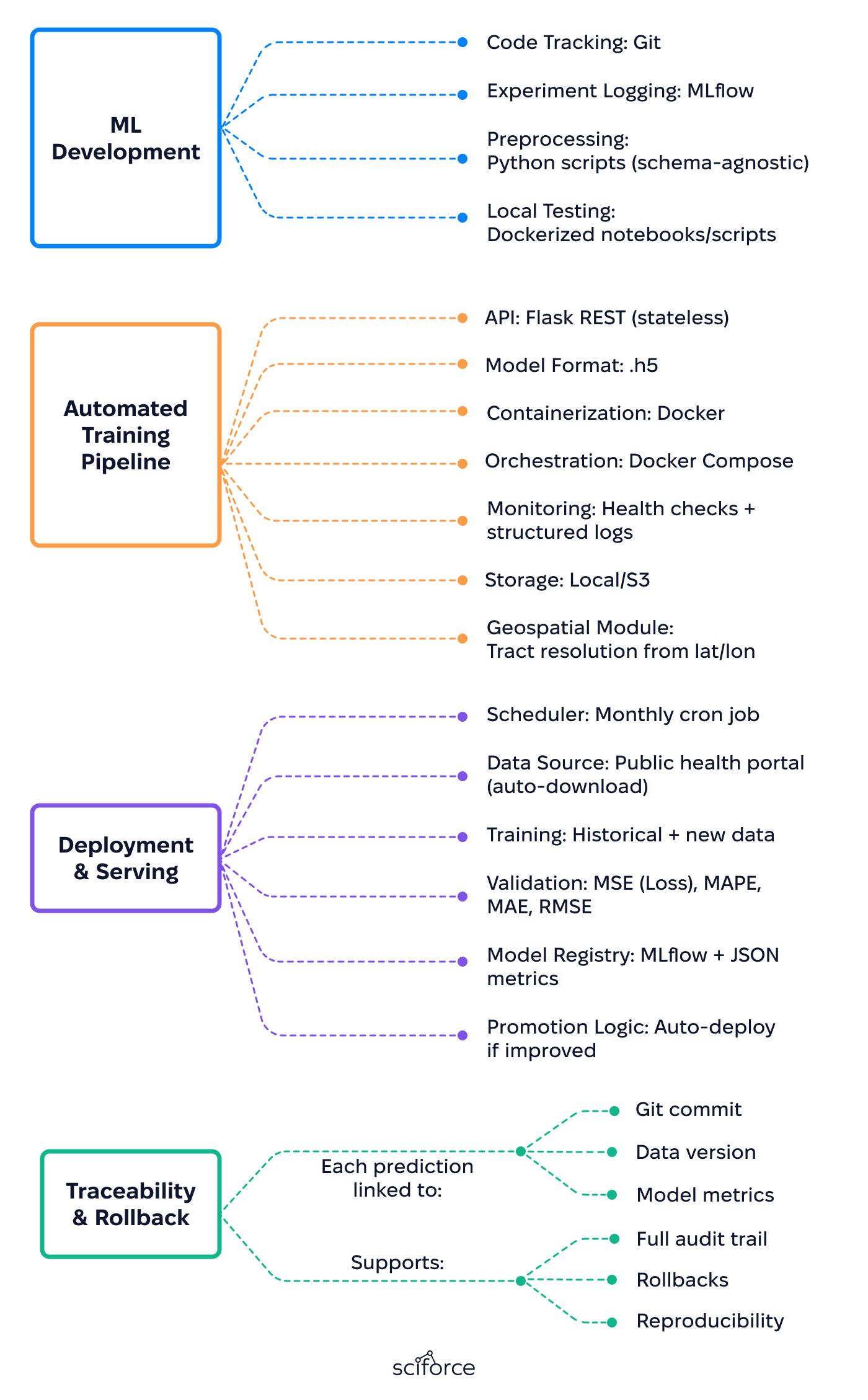
They were built into the system to ensure it operated continuously without developer oversight. A scheduler triggered the pipeline monthly by checking a public health data automation portal for newly published data. If new data was available, the following steps were executed automatically:
All metrics were stored in a versioned JSON file and used to validate performance over time, enabling autonomous model lifecycle management.
3. Deployment & Serving
Deployment and serving were handled through a stateless REST API built with Flask. The trained LSTM model was serialized (e.g., in .h5 format) and exposed via an endpoint that accepted geographic coordinates as input. These coordinates were processed through an embedded geospatial module to resolve the corresponding administrative tract.
The API returned both the current total disease case count and a forecast for the next day. Additionally, users could request aggregated statistics within a defined radius to obtain broader regional data. This architecture enabled seamless integration with external systems, including mobile health apps and institutional dashboards.
4. Monitoring & Reliability
The system followed production-grade fully automated MLOps pipeline for time series forecasting to ensure consistent availability and resilience. Core workflows, including data ingestion, preprocessing, retraining, and evaluation, ran independently of the inference pipeline. This separation meant that failures in upstream automation didn’t impact live predictions.
Health checks monitored each service component in real time, while structured logging enabled proactive issue detection — the broader operational discipline behind this kind of setup is covered in our article on DevOps for AI-powered products, which looks at how teams keep models reliable as conditions evolve. MLOps architecture for continuous model retraining and deployment supported uninterrupted service with minimal manual intervention, even during partial system failures or scheduled retraining cycles.
5. Model Versioning & Traceability
To ensure full transparency and traceability of every forecast, we implemented a robust versioning and deployment workflow using MLflow, Git, and Docker. Each trained model was logged in MLflow alongside:
Metrics were additionally stored in JSON format to support direct comparisons during regular retraining cycles. The final model artifact (.h5 format) was stored locally or in S3 and served through a Dockerized REST API, managed by Docker Compose for reproducibility across environments.
Every prediction made in production was tied to a specific model version, enabling full auditability, reproducibility, and rollback — version-controlled embedding deployments work the same way in our medical semantic search pipeline, where each terminology collection is packaged, versioned, and promoted independently.
These results directly supported the fully automated retraining pipeline: