

Stay informed and inspired in the world of AI with us.
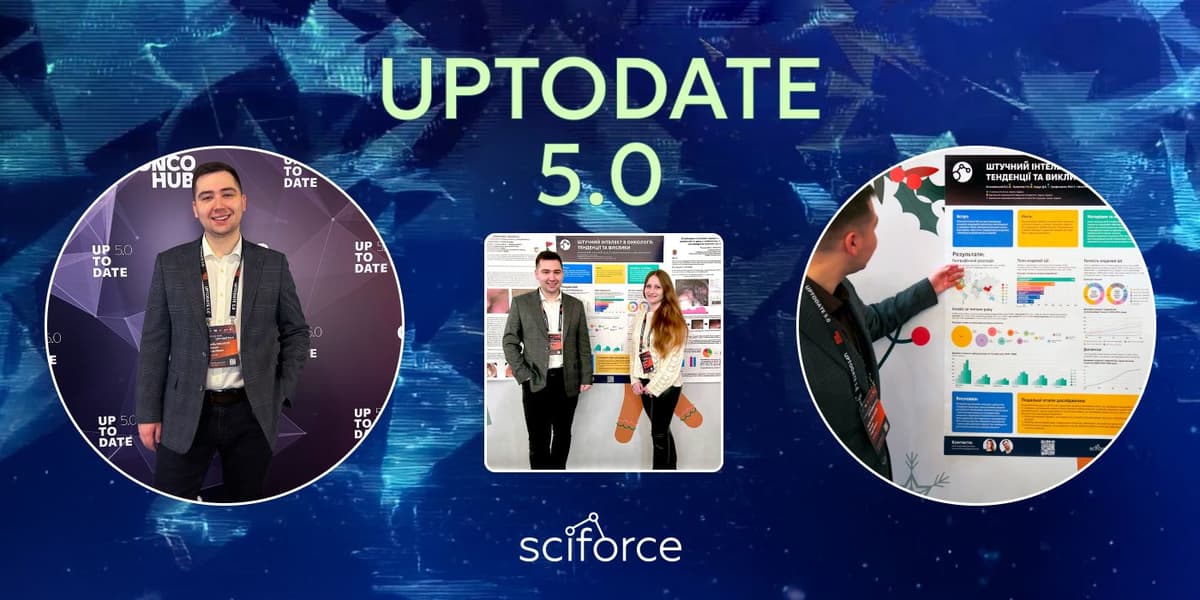
The SciForce Medical team recently attended a major oncology conference in Ukraine. The two-day event in Kyiv brought together over 2,000 experts, including doctors, researchers, and industry leaders. It provided a great chance to learn about the latest advancements in cancer care and connect with potential partners. The conference had a busy schedule of sessions, workshops, and presentations on topics like cancer diagnostics,advanced treatments, and personalized care. Since we couldn’t attend
Published: December 23, 2024
What if businesses could access unlimited, high-quality data without privacy risks or tedious preparation? Synthetic data for AI model training is making this possible, offering a scalable, efficient alternative to real-world data. Gartner predicts synthetic data will surpass real data in AI model training by 2030, with the market growing from $351.2 million in 2023 to USD 2,339.8 million by 2030, at a CAGR of 31.1%. Data preparation is a major hurdle, with data scientists spending over 60% of t
Published: December 9, 2024
LLMs are enabling computers to understand and generate human-like text, making them indispensable in industries ranging from customer service to content creation. The global market for LLMs is expected to skyrocket from $1.59 billion%20market%20size%20in%20terms%20of,79.80%25%20during%202024%2D2030.) in 2023 to $259.8 billion by 2030, with North America alone projected to hit $105.545 million by 2030. The dominance of the top five LLM developers, who currently hold 88.22% of the market revenue,
Published: September 4, 2024
Ever wonder why so many machine learning (ML) models never see the light of day? Despite their huge potential, only 32% of data scientists say their models usually get deployed. Even more shocking, 43% report that 80% or more of their models never make it into production. This means many businesses miss out on the full value of their AI projects. Imagine a retail company spending months developing a sophisticated customer recommendation system, only for it to never be implemented — losing out on
Published: August 7, 2024
Healthcare providers manage an enormous volume of data daily, approximately 137 terabytes, most of which is unstructured. This includes a wide array of formats such as medical images, clinical notes, and genetic test results. Unstructured data processing, crucial for patient care, poses significant challenges due to its complexity and the varied sizes of its components. The volume of healthcare data is rapidly increasing, fueled by the widespread adoption of electronic health records and advance
Published: July 17, 2024
This April, Polina Talapova and Mariia Pahur represented SciForce at the 7th European OHDSI Symposium in Rotterdam – three vivid days of workshops, poster sessions, MindMeetsMachines mapping competition and an oral presentation aboard the SS Rotterdam, a retired ocean liner moored on the Maas river. The symposium's theme was Continuous Collaboration for Living Evidence Generation. The word "living" matters here. Traditional evidence-generation projects are often designed as discrete studies. A
Published: July 21, 2026
Building a telehealth platform at clinical scale means solving for hospital network restrictions, HIPAA compliance and auditability, and the data load of continuous remote monitoring – and the architecture decisions that determine whether it holds up are mostly made in the first few sprints. The engineering debt from early decisions starts showing up at scale: video sessions dropping when hospital firewalls, restrictive egress policies, or network address translation prevent a direct media path;
Published: July 7, 2026
A radiologist on a standard hospital shift may read dozens to well over a hundred imaging studies, depending on subspecialty, setting, shift structure, and case complexity. Each one is a search for something that might be subtle, easy to miss, or buried in noise. At that volume, non-trivial discrepancy or error rate is a known risk in radiology practice, especially under high workload and time pressure. Radiologists are working through growing imaging volumes with a workforce that has never full
Published: June 30, 2026
In 2025, the world’s data centers consumed 485 terawatt-hour of energy, with AI-related demand growing at 50%. By 2030, the consumption is expected to reach 950 TWh – twice as much as today, and equals approximately the entire electricity consumption of Japan. Goldman Sachs forecasts that about 60% of new demand will be met by burning fossil fuels, increasing global carbon emissions to 220 million tons. And as the chart below shows, the emissions cost escalates sharply with each new generation o
Published: June 10, 2026
Equipment failures don't happen out of the blue: pressure drifting lower, or a slightly different vibration pattern precedes the failure over weeks or months. None of these is big enough to cause an incident on its own, but the trend would show that action is already necessary. BlueScope, an Australian steel manufacturer, used to monitor their equipment through visual checks and basic low-level switches, until they introduced Siemens Senseye predictive maintenance system. Half a year after insta
Published: June 4, 2026