Find out more with SciForce free checklist
1. Manual Content Creation
Educators spend 8–12 hours per week developing lesson materials, exercises, and assessments. Creating structured, level-appropriate content is time-consuming, reducing time for student engagement and curriculum expansion, affecting content scalability.
2. Limited Personalization
Pre-set curricula lack adaptability, failing to address individual student proficiency, learning pace, and engagement styles. Without dynamic adjustments, students may struggle with content that is either too advanced or too basic, leading to gaps in comprehension and reduced learning efficiency.
3. Scalability Issues
Expanding course offerings requires significant manual effort in lesson planning, content creation, and assessment design. As new languages, proficiency levels, or topics are introduced, educators must develop materials from scratch, making it difficult to scale efficiently while maintaining content quality and consistency.
4. Lack of Interactive Learning Tools
Traditional text-based lessons and static exercises fail to engage learners, limiting opportunities for active participation, real-time feedback, and immersive practice. Without interactive dialogues, speech recognition, or adaptive exercises, students struggle to develop practical communication skills and remain engaged in the learning process.
5. Cultural & Linguistic Accuracy
AI-generated content must accurately reflect cultural context, idiomatic expressions, and regional language variations to ensure authenticity. Without proper adaptation, lessons may include unnatural phrasing, incorrect cultural references, or generalized translations, reducing their effectiveness and relevance for learners.
1) Automating Content & Assessment Creation
The LLM-powered education platform simplifies AI tools that automate lesson creation and assessments, saving educators time and effort. Using advanced AI for teacher productivity with language models and optimized prompts, it generates high-quality lessons, quizzes, and personalized feedback tailored to different skill levels.
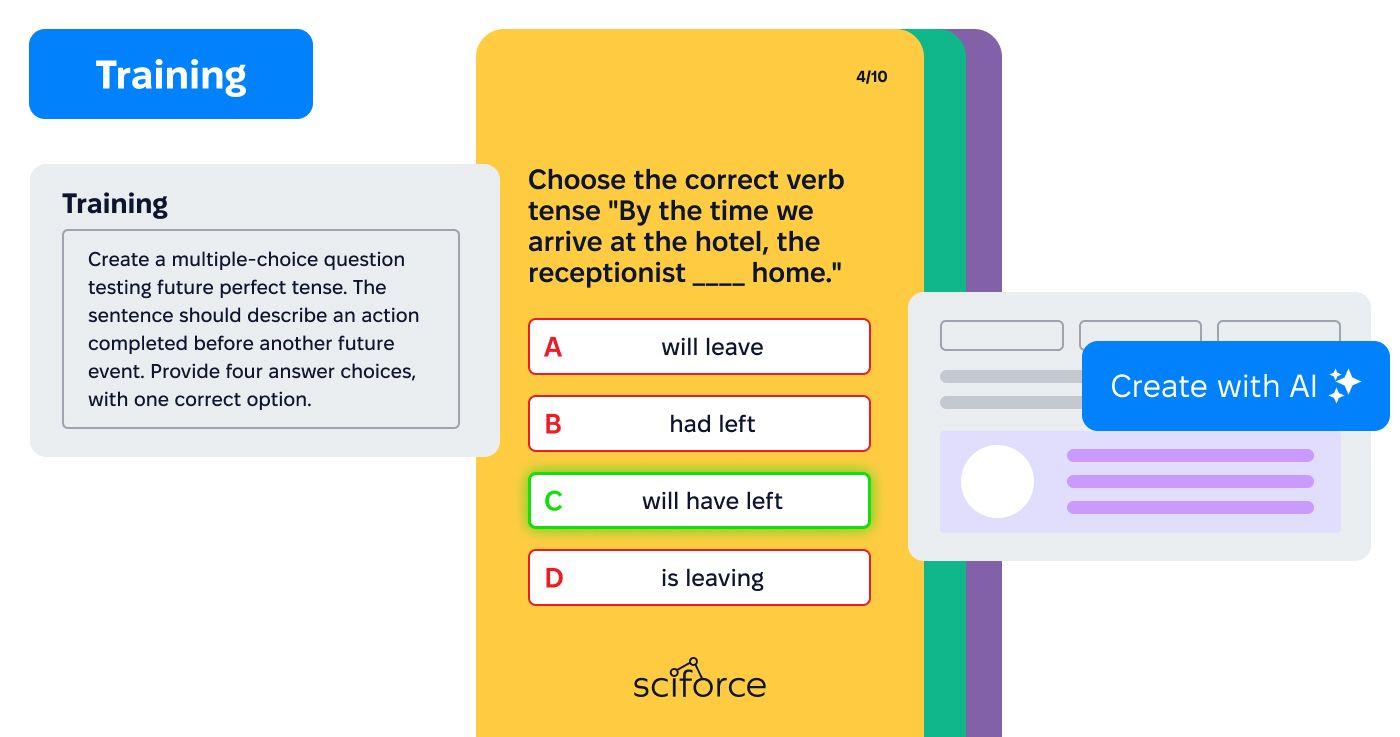
By automating articles, dialogues, grammar exercises, and quizzes, the platform helps educators scale their curriculum efficiently while ensuring accuracy and consistency.
2) Personalization & Adaptive Learning
The solution implements an adaptive learning system for personalized language education by analyzing student progress and adjusting exercises, recommendations, and difficulty levels in real time. This ensures that learners receive personalized education with AI rather than a one-size-fits-all curriculum.
Find out more with SciForce free checklist
3) AI-Powered Writing & Speaking Feedback
The platform provides instant writing corrections and interactive AI lessons, speaking exercises, helping students improve grammar, sentence structure, and pronunciation. AI feedback points out mistakes, explains corrections, and gives helpful suggestions. For speaking practice, the platform delivers speech recognition and pronunciation feedback for language learners, checking pronunciation and fluency and providing real-time guidance. This allows students to keep improving their writing and speaking skills on their own, without always needing an instructor.
4) Interactive & Engaging Learning Materials
The platform supports interactive AI-driven language learning with dialogues and video to simulate real-life conversations and cultural situations. Students can practice role-play scenarios, such as ordering food, having a job interview, or asking for directions. AI-powered speech synthesis helps with pronunciation, while interactive videos with subtitles improve vocabulary and listening skills. These tools make learning more practical and engaging, helping students feel more confident using the language in real situations.
5) AI-Driven Speech & Video Learning
The platform improves listening and speaking skills using Text-to-Speech (TTS), speech recognition, and AI-generated videos for a more interactive learning experience.
6) AI-Assisted Curriculum Planning & Progress Tracking
The AI teaching assistant creates lesson plans based on learning goals and keeps them aligned with the curriculum. It tracks student progress by analyzing quiz results, completed activities, and learning trends. Educators can use this data to adjust lesson difficulty, address weak areas, and improve teaching strategies.
AI-Generated Lesson Content
Creates articles, dialogues, and stories in multiple languages, adjusting complexity, vocabulary, and grammar to match proficiency levels and learning objectives. AI ensures cultural accuracy and regional language variations, making content both authentic and contextually relevant.
AI Writing Tutor
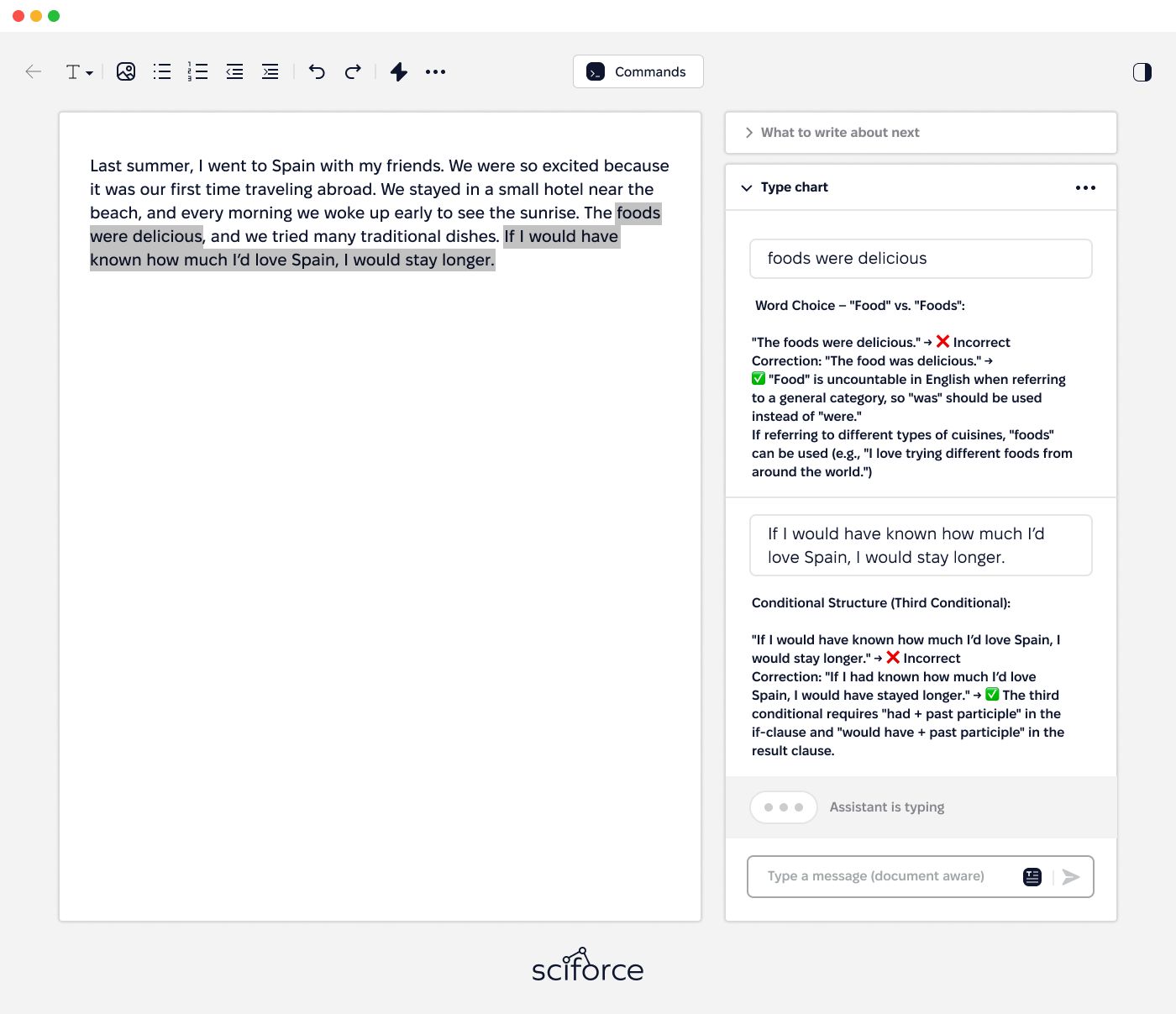
Automated grammar correction tools check grammar, spelling, and style in real time, suggesting better phrasing and word choices to improve clarity and fluency. It explains corrections to help learners understand sentence structure, tone, and grammar rules. The AI adjusts feedback based on skill level, giving beginners clear guidance and advanced learners more refined suggestions.
Smart Assessment Generator
Creates quizzes, exercises, and tests that adjust in difficulty based on student progress. Automatically provides answer keys and explanations for mistakes to support learning. Includes multiple question types, such as multiple choice, fill-in-the-blank, and open-ended questions, for a well-rounded assessment experience.
Language Pattern Recognition
Identifies grammar rules, sentence structures, and vocabulary patterns, grouping words by usage and context. Generates example sentences to help learners understand how words and phrases are used naturally, making it easier to remember and apply them.
Interactive AI Dialogues
Creates realistic conversations based on different situations, using relevant vocabulary and grammar. Adjusts to different skill levels, allowing learners to practice casual, formal, and professional dialogues. Includes interactive role-playing, where users can respond in guided or open-ended discussions for more natural learning.
AI Curriculum Planning
Recommends lesson objectives and learning paths based on student skill levels and course goals. Ensures lessons follow curriculum standards for smooth progression. Tracks student progress and engagement, giving educators insights to adjust lessons and improve learning outcomes.
Text-to-Speech & Pronunciation Support Turns lesson text into clear, natural speech with options for different accents, speeds, and tones. Highlights key pronunciation points and allows learners to adjust pitch and pace for better listening and speaking practice. Provides detailed pronunciation feedback to help improve clarity and accent.
AI Video Generation Turns lesson text into engaging AI-generated educational videos with animated dialogues, vocabulary visuals, and cultural references. Adapts content to match real-world scenarios and regional language variations, helping learners understand and apply language in context.
1. Discovery & Prototyping
We started by analyzing curriculum requirements and educator workflows to identify key challenges and opportunities for AI integration. A proof-of-concept (PoC) was developed to test AI-driven assessments, content creation, and adaptive learning capabilities. Throughout this phase, we gathered feedback from educators to refine the system, ensuring it meets real-world teaching needs and enhances learning effectiveness.
2. Development & Integration
The team developed backend APIs to power AI-driven features and seamlessly integrated AI models into the platform. We fine-tuned the AI to generate structured lessons, personalize exercises, and automate assessments while ensuring alignment with curriculum standards. Real-time feedback for writing and speaking tasks was implemented to enhance student engagement. The system was optimized for accuracy, adaptability, and scalability, allowing educators to efficiently manage coursework while maintaining high-quality learning experiences.
3. Infrastructure & Security
The solution runs on AWS, leveraging managed cloud services for computing, storage, and orchestration. AI services operate in containerized environments using Docker, ensuring modularity, scalability, and efficient resource allocation. Data storage is structured across multiple systems:
The platform employs end-to-end encryption to protect sensitive data. All transactions are secured using HTTPS/TLS encryption, and stored data is encrypted at rest. The system complies with data protection regulations, ensuring secure user authentication, access controls, and regular security updates.
4. Testing & Validation
We carried out extensive testing with educators and students to assess usability, content accuracy, and the AI’s ability to adapt to different learning needs. Educators evaluated the relevance of AI-generated lessons, quizzes, and feedback, while students tested personalized exercises and real-time writing and speaking assessments. Performance data and user feedback guided refinements, improving AI-generated content quality, adaptive learning precision, and overall user experience.
5. Deployment
We introduced AI-powered features gradually to ensure a smooth transition and easy adoption. The first phase focused on key functions, allowing educators and students to get familiar with AI-driven content creation, adaptive learning, and automated assessments. Feedback from early users helped us improve AI recommendations, enhance usability, and fine-tune system performance. Each stage included real-time adjustments based on user input, ensuring stability and scalability.
6. Continuous Improvement
We frequently update the model to improve content accuracy, tailor lessons to students, and enhance automated assessments. The platform evolves with curriculum changes, educational standards, and user feedback to keep learning effective. Updates focus on simplifying lesson planning, improving real-time feedback for writing and speaking, and tracking student progress more precisely.
Using education LLM for reducing teacher workload and improving outcomes, as AI-generated materials cut manual effort by 60%, speeding lesson development significantly.
Adaptive AI-driven exercises tailored to each student’s skill level improved learning efficiency by 30%, accelerating language proficiency compared to traditional teaching methods.
AI-powered dialogues, speech synthesis, and educational videos increased student engagement, leading to a 40% improvement in retention and comprehension by simulating real-world communication.
The platform’s AI classroom automation capabilities enabled the client to expand their language offerings three times faster while maintaining high-quality content, all without increasing operational costs.