Find out more with SciForce free checklist
1. Unpredictable Drive-Thru Audio Conditions
Speech recognition in noisy outdoor environments was required because Drive-Thru microphones capture audio in uncontrolled outdoor settings filled with idling engines, traffic, and other background noise. Customers don’t always face the mic directly and may speak softly or from inside larger vehicles. Building an ASR system for drive-thru voice ordering required the speech recognition system to reliably extract clean, intelligible audio from noisy, inconsistent input.
2. Lack of Explicit Start/Stop Signals
Unlike traditional assistants that rely on wake words (e.g., "Hey Siri"), fast food voice assistant users speak naturally — sometimes to the AI, sometimes to other passengers. The system had to determine in real time whether speech was intended for it, without relying on voice activation cues, and avoid interrupting or misidentifying casual conversation as part of an order.
3. Natural and Informal Speech Variability
Customers don’t speak in scripted phrases. They use casual language, mid-sentence changes, slang, and fillers like “uhh” or “lemme get a…” — often out of order and with pauses. The ASR system needed to transcribe these fluid, sometimes incomplete, speech patterns accurately, even across multiple turns of conversation.
4. Multiple Speakers and Language Switching
Orders were often placed by groups rather than individuals, leading to overlapping voices and side chatter. Additionally, multilingual ASR for drive-thru restaurants needed to automatically detect whether the customer was speaking English or Spanish — or even switching between the two mid-interaction — and still maintain multilingual customer experience without disruption.
5. Domain-Specific Speech Recognition for Fast Food Menus
Fast food menus include unique naming conventions, promotional item names, and brand-specific phrases — many of which don’t appear in standard language corpora. The ASR engine had to be trained speech-to-text for fast food industry to recognize terms like “Triple Stack Deluxe” or “Mega Cheddar Supreme,” even when spoken quickly or mispronounced.
6. Low-Latency, High-Confidence Transcription
Real-time ASR for quick service restaurant ordering required the pipeline to return transcriptions within ~400 milliseconds while maintaining high word accuracy. When confidence dropped below a set threshold — especially on critical items like "fries" or "combo" — the system had to trigger smart clarification prompts instead of passing incorrect input downstream.
1) End-to-End AI-Powered Drive-Thru Automation
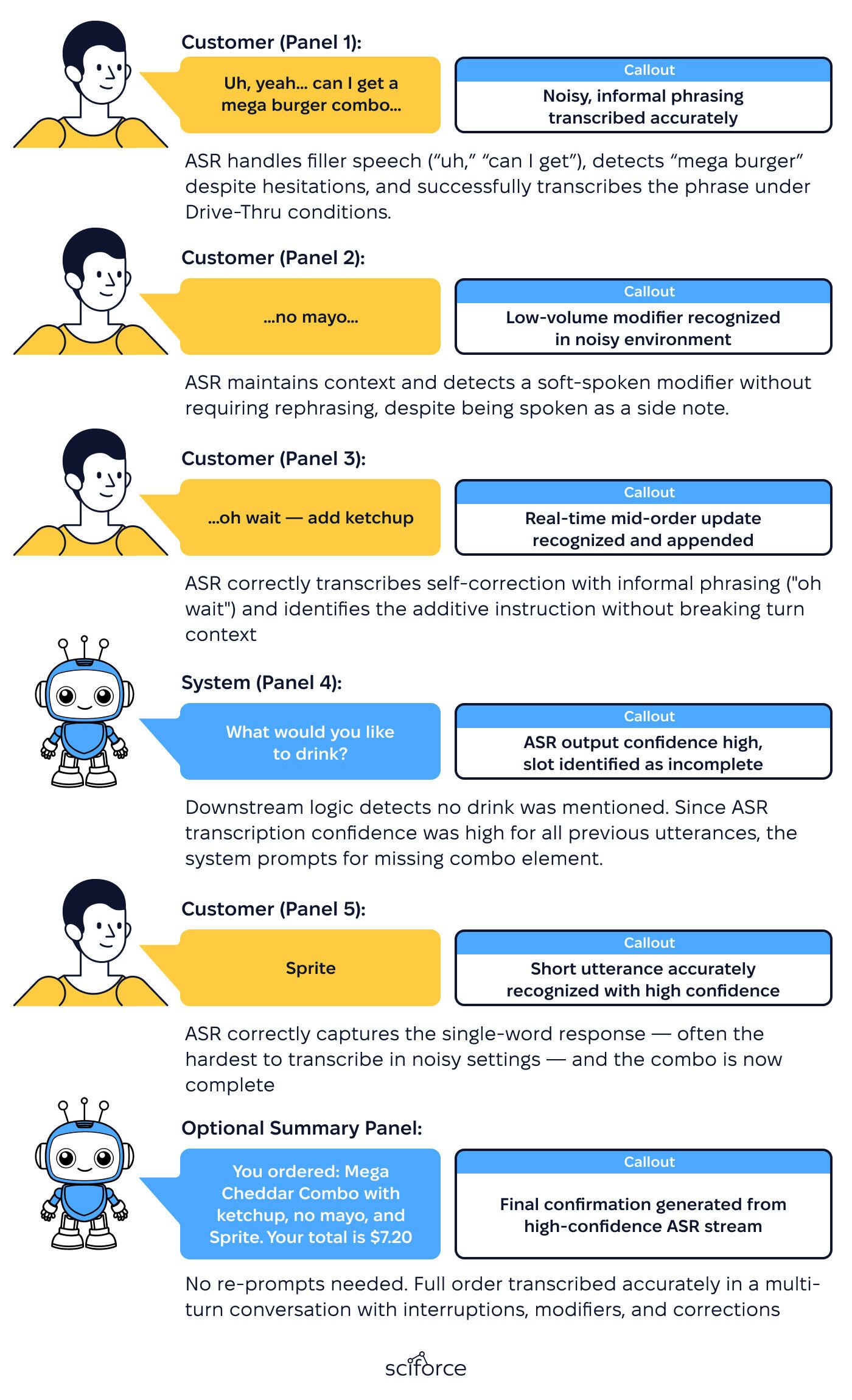
Voice AI for fast food drive-thru automation fully automates the Drive-Thru experience as a voice-driven ordering system, starting with real-time speech detection and transcription. A custom-built Voice Activity Detection (VAD) model continuously monitors ambient audio to determine when a customer is addressing the AI, even in the presence of car noise, conversations, or engine sounds. The ASR engine then transcribes natural, free-form speech — including informal phrasing, mid-sentence changes, and pauses — into accurate text under noisy, open-air conditions.
Once transcribed, the system checks for gaps in the order (e.g., missing drink for a combo) and generates appropriate follow-up prompts. The finalized order is sent directly to the restaurant's POS terminal without human intervention — structuring that order from informal speech is covered in depth in our menu-aware NLP case, which handles combo logic, modifier parsing, and branded item mapping downstream of transcription.
2) Efficient, Low-Latency ASR Pipeline
The entire voice processing pipeline — from speech detection to recognition and response — is optimized for real-time performance. Custom ASR models, designed specifically for the fast food domain, operate efficiently on CPU hardware to minimize infrastructure costs. Even under heavy load across hundreds of Drive-Thru lanes, the average end-to-end response time stays under 400 milliseconds, ensuring a smooth, uninterrupted conversation flow.
3) Multi-Language Support
The ASR engine supports real-time language detection, automatically recognizing whether the customer is speaking English or Spanish — even mid-sentence — without requiring manual language selection. This enables fluid, mixed-language conversations and accurate transcription of bilingual orders, regardless of phrasing or accent.
4) Real-Time Staff Communication via Voice
Restaurant staff can use voice commands to report out-of-stock items or technical issues, such as “We’re out of fries” or “Shake machine’s down.” These updates are parsed and acted upon in real time, even when spoken quickly or in noisy kitchen environments. The ASR engine distinguishes these operational commands from casual staff chatter and routes them for immediate handling by the system.
Natural Voice Interaction
The system supports free-form speech, allowing customers to place orders naturally without learning scripted commands or using trigger words. Using Voice Activity Detection (VAD), it continuously monitors audio input to identify when someone is speaking to the AI versus chatting with passengers — enabling a smooth, human-like ordering experience.
Flexible Order Editing
The system accurately handles mid-order corrections and changes, even when phrased informally or spoken in noisy conditions. Customers can say things like “Actually, make that a chicken sandwich instead” or “Wait — cancel the Coke,” and the ASR engine captures the intent without needing them to repeat the entire order. Real-time updates ensure that modifications are processed smoothly, allowing the interaction to continue naturally without interruption.
Order Confirmation
Once the order is complete, the AI automation for restaurants uses high-confidence ASR transcripts to generate a full verbal summary — including each item, any modifiers (like “no mayo” or “add ketchup”), and combo components. It then announces the total cost before sending the order to the kitchen. This final confirmation step reduces errors from misheard items, provides transparency to the customer, and ensures everything was transcribed and interpreted correctly before fulfillment.
1. Dataset Collection
Thousands of audio samples were gathered directly from Drive-Thru lanes at various fast food restaurants across different regions. These included real customer orders captured during live service, featuring diverse accents, spontaneous phrasing, interruptions, and environmental noise such as idling engines and passing cars. This data was used for domain-specific speech model training to handle real-world variability in Drive-Thru conditions.
2. Transcription & Annotation
Audio recordings were processed using automatic speech recognition, then manually reviewed to correct transcription errors — especially in challenging segments like brand-specific menu names (“Triple Stack Deluxe”), soft-spoken modifiers (“extra pickles”), and informal phrasing. Annotators also marked the exact start and end times of each utterance to support fine-tuning of Voice Activity Detection (VAD) and segmentation models. This corrected, time-aligned transcription data became the foundation for training high-accuracy ASR systems under Drive-Thru conditions.
3. Data Preparation
After transcribing the recordings, the team cleaned the data by removing poor-quality audio, off-topic conversations (e.g. “What do you want?” between passengers), and duplicates. The cleaned dataset was then split into training, validation, and test sets. Each set included a mix of restaurant types (e.g. burger chains, chicken-focused menus), ordering styles (like “I’ll take a Big Mac and fries” vs. “Can I get the combo with the cola instead?”), and speaking patterns — including different regional accents, varied speeds, and informal phrasing. To avoid bias, no recording appeared in more than one set.

4. Model Training
The team trained several custom models tailored to Drive-Thru ordering:
All models for AI-powered restaurant operations were trained using labeled data from real fast-food Drive-Thru sessions and optimized for CPU-based inference. Where Drive-Thru ASR trains for noise and speed, our impaired speech recognition system tackles the opposite challenge — high variability in pronunciation, pacing, and articulation — using the same multi-stage fine-tuning approach
5. Latency Optimization
Models were evaluated for accuracy, speed, and CPU voice ordering efficiency. Only those that performed reliably without sacrificing recognition quality were selected to support cost-effective deployment across Drive-Thru locations. The full processing pipeline — from VAD to speech-to-text, and response generation — was optimized to maintain an average response time under 400 milliseconds, enabling natural, real-time interactions without delays or interruptions.
6. Confidence & Error Handling
The system monitored recognition confidence in real time. When the confidence score for a customer’s request dropped below a set threshold, the AI for quick service restaurants (QSR) would ask a clarifying question (e.g., “Could you repeat that?” or “Did you mean cheeseburger or fishburger?”) rather than risking an incorrect order. To maintain menu-specific accuracy, a separate Word Error Rate (WER) was calculated for core menu terms — the factors that drive WER in production environments like this are explored in our speech recognition accuracy guide.
7. Real-Time Integration & Deployment
The system sent finalized, structured orders directly to kitchen POS terminals as soon as the customer confirmed them, removing the need for manual input and speeding up order processing. Staff could also speak commands like “fries out of stock” or “shake machine not working” to update the system in real time. These voice inputs adjusted the AI’s behavior immediately, ensuring unavailable items weren’t offered and that recommendations matched current inventory.
Order errors decreased by 10–15% due to high-confidence speech recognition and clarification prompts.
Automated handling of orders, faster response generation, and smart prompts helped decrease average order time from ~110 seconds to under 90 seconds per customer.
With the ordering stage fully automated, restaurants reallocated staff to kitchen and fulfillment roles, maintaining throughput during peak hours with fewer front-line workers.
The AI’s upselling feature — suggesting upgrades, combos, or add-ons — consistently raised ticket size across pilot locations.