1. Flexible Language Understanding
Customers use a wide range of informal phrases, synonyms, and branded terms to describe menu items. The menu-aware NLP system for real-time food ordering must interpret expressions like “double burger with cheese” or “Mega Cheddar” as consistent, structured entries—despite non-standard or creative language.
2. Context Dialogue Management in NLP
Orders are rarely linear. Customers often pause, revise, or add items and modifiers across multiple sentences. The system must maintain order context throughout the interaction, updating the structured output dynamically without losing track of prior information.
3. Menu Structure and Dependency Resolution
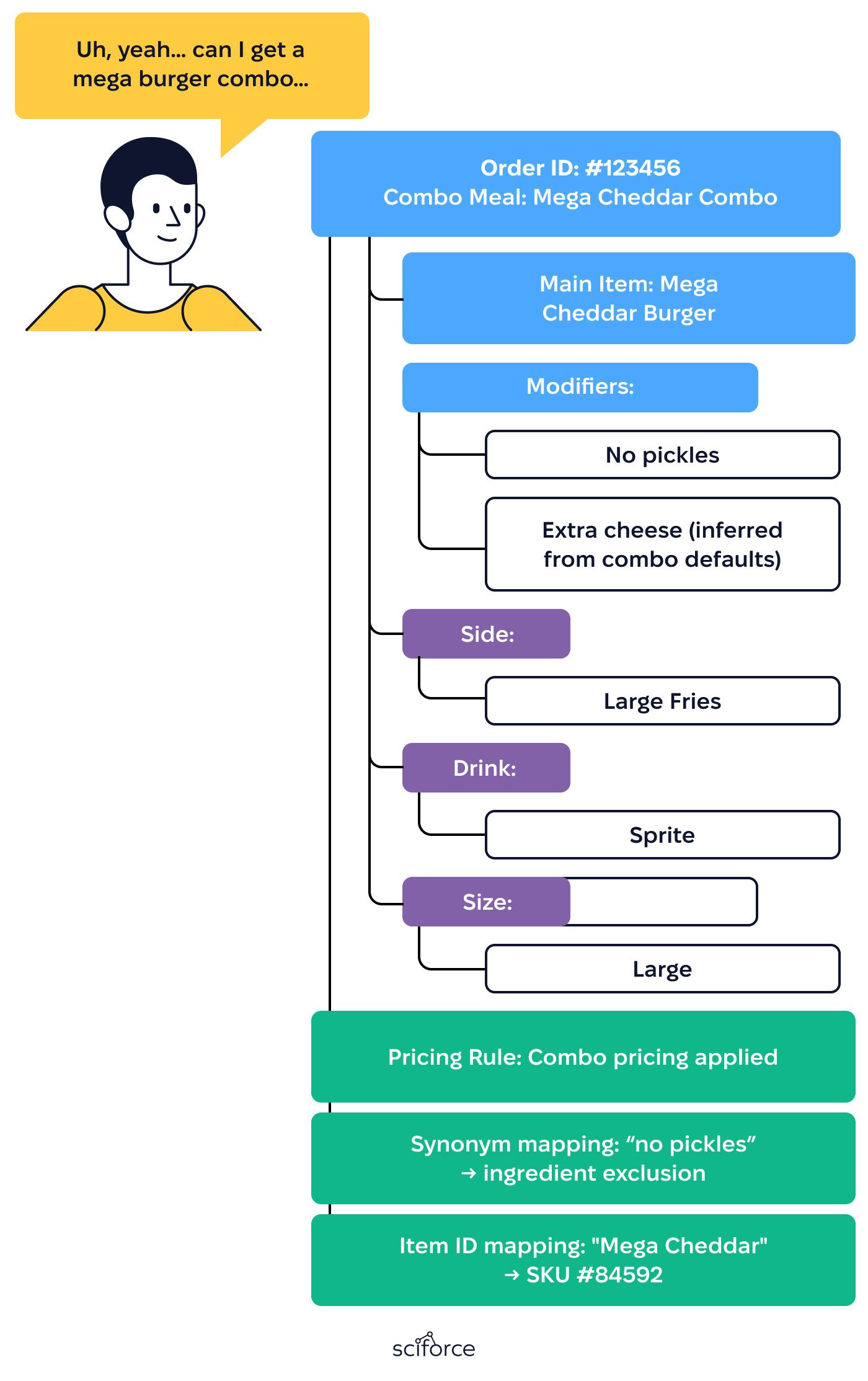
Each restaurant’s menu is transformed into a structured, AI-ready format that includes combos, optional and required components (e.g., drinks, sauces), and custom item hierarchies. The NLP system enables real-time order parsing with menu dependencies and pricing logic, detecting missing information and dynamically restructuring orders for accurate fulfillment and pricing. It also applies pricing rules — recognizing when individual items form a combo and automatically restructuring the order for accurate pricing and fulfillment.
4. Real-Time Menu Management with AI and Upselling Logic
Menus change frequently with new items, promotions, or out-of-stock components. The NLP system must incorporate updates without delay and support upselling by recognizing when a customer’s order could be improved or bundled for a better deal.
1) Custom NLP Engine
A domain-specific natural language processing model was developed to demonstrate how to convert natural speech into structured restaurant orders, handling informal, inconsistent, and brand-specific language used in food ordering. Originally built in-house for accuracy and control, the system is now gradually evolving toward an LLM-based NLP pipeline (e.g., OpenAI) to support greater flexibility and scalability – the upstream layer that produces the speech input for this system is our Drive-Thru ASR case, built to handle noisy outdoor environments, multilingual input, and sub-400ms transcription latency.
Find out more with SciForce free checklist
2) Intelligent Menu Structuring and Pricing Logic
POS menus were restructured into a machine-readable format with clear hierarchies, combo definitions, and dependency rules. The real-time POS system integration accounts for required and optional components, nested items, and pricing logic, enabling the NLP model to automatically restructure orders—e.g., recognizing when separate items qualify as a combo and adjusting the price accordingly.
3) Synonym Mapping and Branded Term Handling
Extensive synonym dictionaries were created to support synonym mapping for NLP, recognizing varied customer phrasing, such as “double cheeseburger,” “burger with double cheese,” or “mega cheeseburger.” The system also maps marketing-driven names (e.g., “Mega Cheddar,” “Hero Meal”) to the correct internal product IDs, ensuring consistent interpretation across informal and branded language.
4) Multi-Turn Conversational AI and Context Tracking
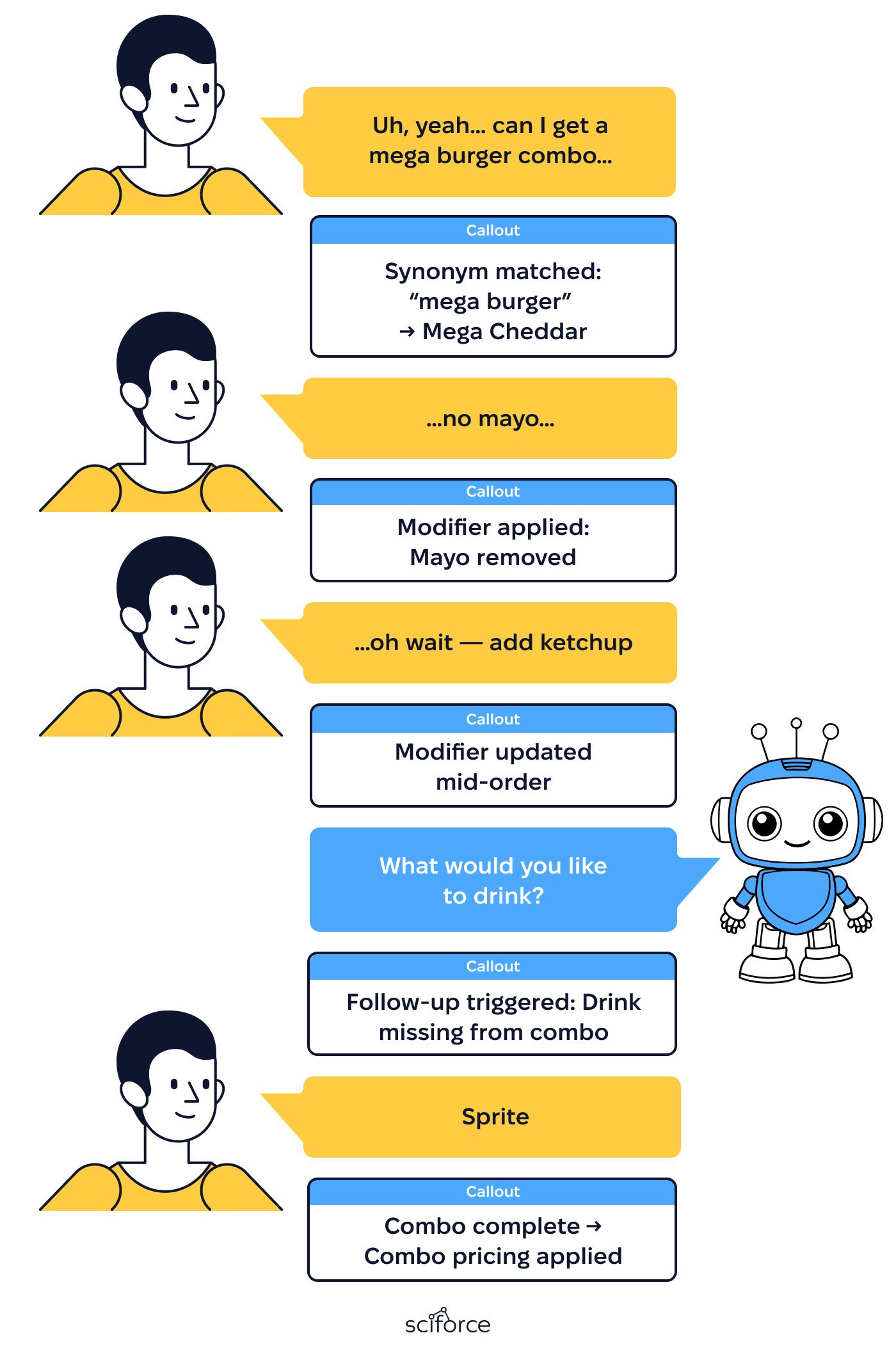
The system operates as a contextual AI ordering system, maintaining order context across multiple dialogue turns, allowing customers to add, modify, or revise items mid-conversation. This ensures the order structure stays coherent and up to date, even with fragmented or non-linear input.
5) Ground Truth Data and Model Training
Structured "ground truth" data was created by mapping real customer speech to JSON-style order representations. Training combined manual transcription, automated labeling, and segmented datasets by brand to ensure broad coverage and model generalization.
Natural Speech-Based Food Ordering Experience
Customers can speak naturally with AI chatbot for food ordering, using informal, unstructured language, including pauses, corrections, and filler words. The system interprets input without relying on fixed syntax, enabling a smooth, conversational ordering flow.
Combo Detection and Dynamic Pricing
The system functions as an NLP system for combo detection and dynamic pricing, detecting when items qualify for a combo, restructuring the order, and applying bundled pricing automatically. Combo behavior was customizable per restaurant, either applied automatically or confirmed with the customer based on each location’s protocol.
Support for Branded and Promotional Menus
The system interprets marketing-driven item names and maps them to the correct structured menu entities, ensuring accurate recognition. It also adapts quickly to seasonal updates and promotional menu changes.
Multi-Turn Interaction and Corrections
The system tracks order context across dialogue turns, allowing customers to add, modify, or clarify items mid-order while keeping the overall structure consistent and accurate.
Multilingual Understanding
The system automatically detects the spoken language—such as English or Spanish—and adjusts its interpretation accordingly, ensuring accurate and consistent responses across supported languages.
Upselling and Suggestive Ordering
The menu-aware NLP integrated with voice ordering systems identifies real-time upsell opportunities, and presents relevant suggestions to the customer — how AI upselling fits into broader restaurant operations is covered in our retail and restaurant AI article.
1. Model Type and Evolution
The NLP system was first developed in-house, specifically for handling fast food orders with informal and varied customer language. It was designed to be cost-effective and easy to scale across many restaurants. As the restaurant AI assistant project grew, the team began moving toward large language models (LLMs), including OpenAI, to make the system more flexible — see how LLMs handle informal query interpretation in our LLM-powered search article.
2. Data Preparation and Ground Truth Creation
Real customer audio recordings collected from Drive-Thru interactions at partner restaurants. We used a mix of manual and automated transcription, with timestamps marked for each speech segment.
Transcribed orders were mapped to structured, JSON-style representations reflecting the full logic of the order—including main items, modifiers, dependencies, and updates made over multiple dialogue turns, for example: “Big Mac with ketchup and mayo, a Coke, and fries.”
the dataset was split into training, validation, and test sets with careful segmentation to ensure balanced representation across different restaurant brands and avoid overlap between recordings from the same day or customer session
3. Menu Structuring for NLP Integration
Menus from restaurant POS systems were not designed for natural language understanding (NLU) – they lacked structure, consistency, and machine-readable formatting. To deal with it, the team manually restructured each menu into a format suitable for NLP interpretation. This included:
Extensive synonym dictionaries were developed to interpret the many ways customers refer to the same menu item—for example, “double cheeseburger,” “burger with double cheese,” or “mega burger.” The system also supports branded and promotional names like “Mega Cheddar” or “Hero Meal,” linking them to the correct internal product IDs to ensure consistent recognition and accurate order processing.
4. Training and Evaluation
Domain-specific NLP for fast food menus was trained on a curated dataset of real customer interactions, including transcribed audio and structured orders. The data captured a wide range of restaurant brands, menu setups, and natural speech patterns—such as informal phrasing, corrections, and background noise. Training focused on handling language variability, understanding complex menu logic, and maintaining context across multi-turn dialogues for reliable performance in real Drive-Thru settings.
Model performance was assessed using accuracy, coverage of key menu phrases, and precision in handling domain-specific terms to ensure reliable interpretation of food-related language.
Model behavior was continuously tracked through performance metrics, with special attention to critical errors—such as misrecognizing “cheeseburger” as “fishburger.” When accuracy thresholds weren’t met, additional data was collected and the model retrained to improve reliability and reduce high-impact mistakes.
5. Order Logic and Context Handling
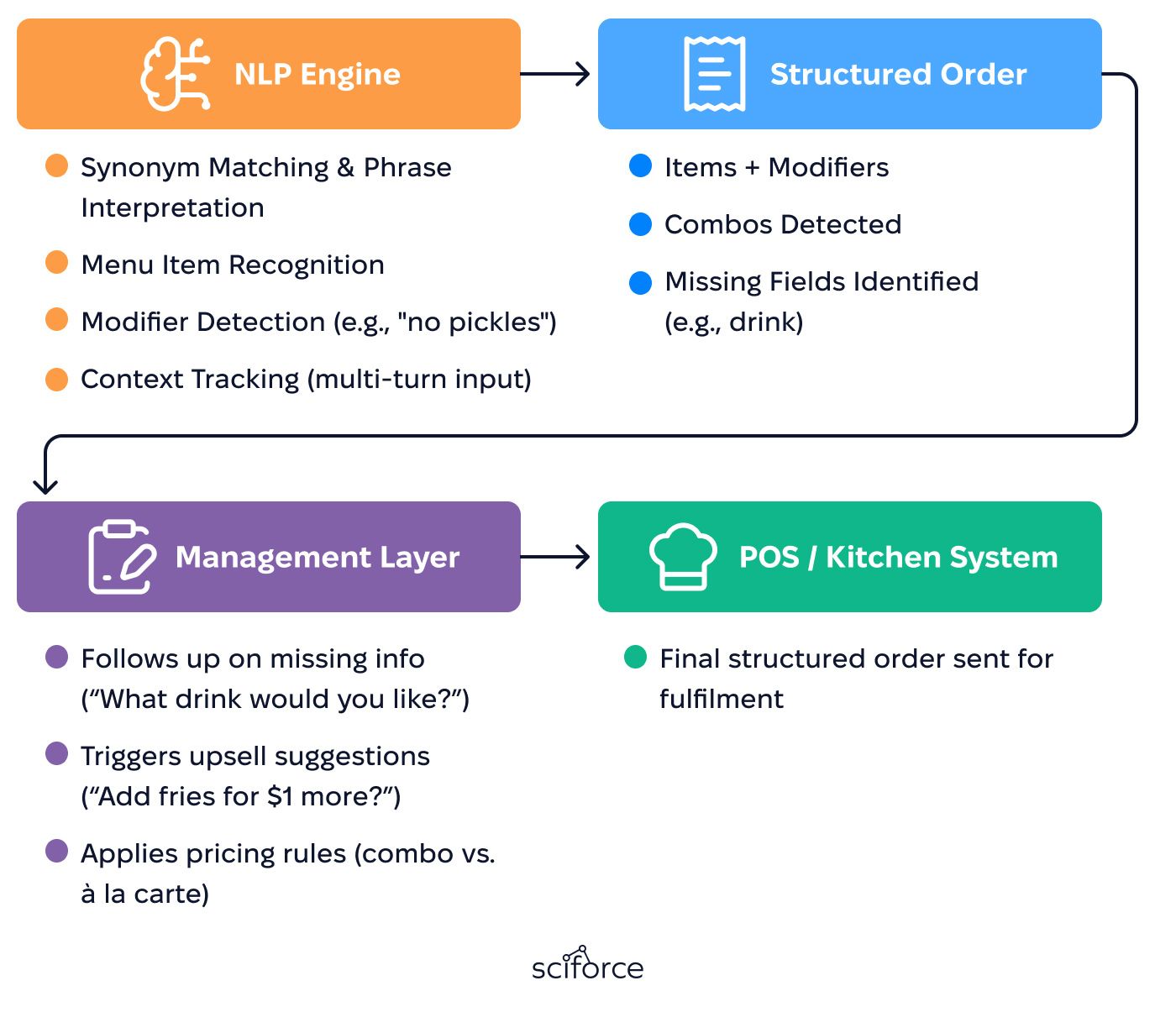
The NLP model outputs a structured representation of each order, identifying main items, modifiers (e.g., sauces or toppings), and checking for completeness based on predefined menu rules. For example, if a combo is ordered without a drink, the system detects the missing field and prompts the customer with a follow-up question like “What would you like to drink?”
This logic is handled by a dedicated management layer that ensures every order is complete and valid. The system also maintains context across multi-turn dialogues, allowing customers to revise or add to their order naturally, with real-time updates to the structured output.Technical Highlights
The NLP system achieved 85–88% accuracy in converting natural, informal speech into structured orders, reducing manual corrections by over 70% and ensuring consistency across varied customer phrasing.
With over 90% recognition of synonyms and branded terms, the model reliably interpreted phrases like “burger with double cheese” or “Mega Cheddar” and maintained context across dialogue turns with over 95% consistency.
Thanks to structured integration, the system supported same-day updates for new items, promotions, and stock changes—keeping NLP performance aligned with fast-changing menus.
Integrated upsell logic, powered by structured NLP outputs, helped boost average order value by 10–12%, identifying upgrade opportunities and suggesting combos in real time.