
1. Data Fragmentation and Overload
The client faced challenges with financial data coming from different platforms in various formats, leading to inefficiencies and difficulties. The large amount of unstructured data made it hard to process, organize, and provide clear, useful insights for their customers.
2. Infrastructure Complexity
The client’s infrastructure was split between OVH and Azure, making it harder to scale and manage effectively. Moving some components to Azure revealed the challenges of maintaining consistency and showed the need for a more unified and flexible system.
3. Security and Compliance Requirements
The financial data needed to meet strict regulations, and DevOps for financial services with strict security and compliance required strong access controls, encryption, and audit-ready DevOps pipelines. These measures were especially important for passing audits and preventing unauthorized access or breaches.
4. Technical Limitations of Previous Solutions
Previous solutions, such as security tunnels, provided encryption but introduced challenges like complex configurations and unreliable performance in certain situations. The lack of a modern, scalable infrastructure further limited the ability to support growing business needs.
5. Financial Infrastructure Automation & Scalability
The existing infrastructure had trouble scaling efficiently and required a lot of manual work to handle changing workloads. There was also a need to automate deployments and updates across development, testing, and production environments to reduce delays and errors.
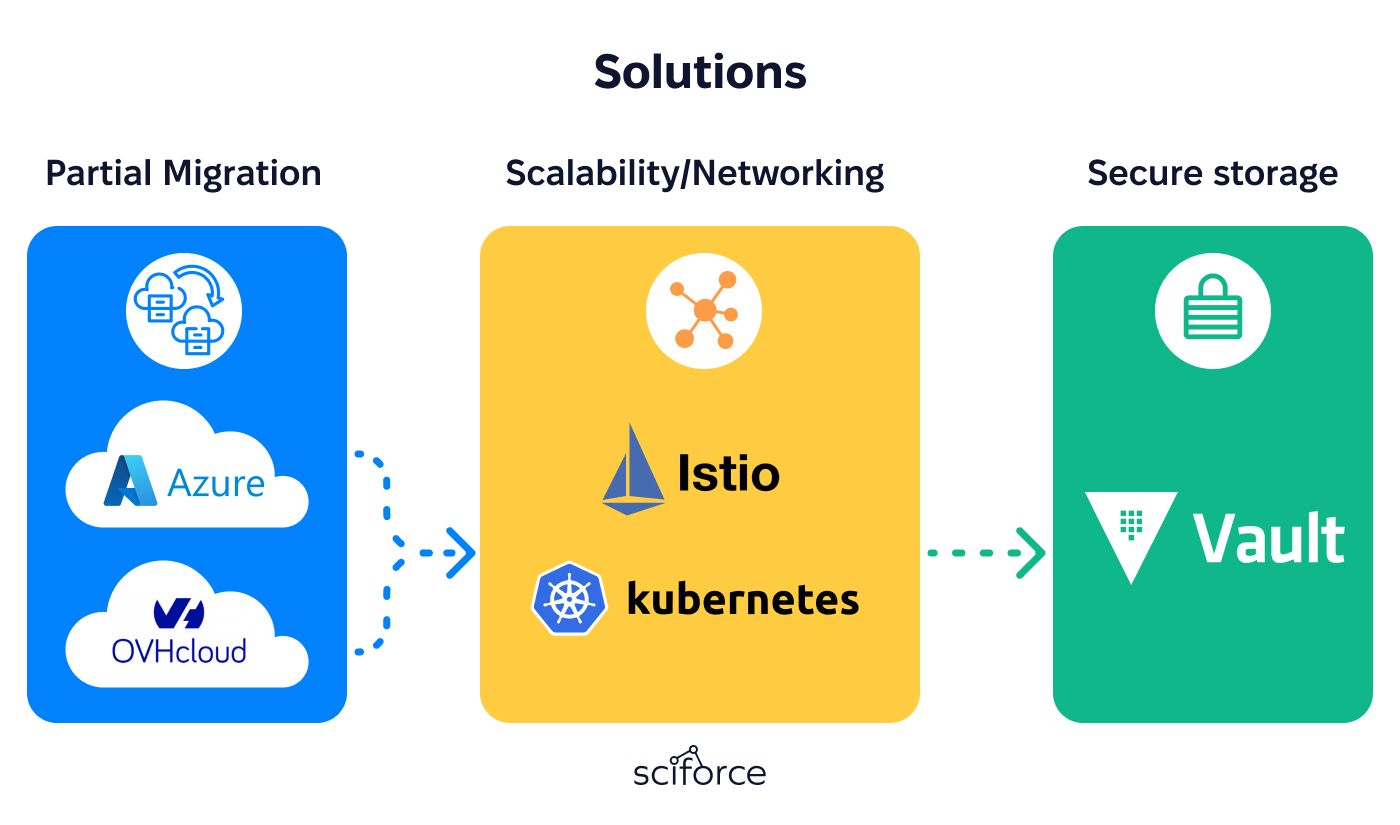
The project focused on how to modernize fintech infrastructure with DevOps, upgrading the existing setup and improving financial data management to support scalable, secure growth. This cloud transformation in finance relied on a hybrid cloud DevOps architecture for fintech platforms, with critical components migrated to Azure while core workloads remained on OVH to maintain stability.
1) Partial Migration:
Critical components, including on-premise systems and essential services, were moved to Azure to meet urgent needs, while most workloads continued running on OVH. This ensured stability during the transition.
2) Kubernetes Service Mesh:
Security tunnels were replaced with a Kubernetes-based service mesh, improving scalability and simplifying network management. Strict tenant isolation through Kubernetes networking is something we've tackled from a different angle too — in a multitenant virtual datacenter where each client gets a fully isolated cluster with its own compute, storage, and routing.
3) Enhanced Security:
Vault was implemented to demonstrate how to manage sensitive financial data with Vault in DevOps pipelines, enabling secure storage, encryption, and compliance with financial regulations. Financial audits confirmed the system’s security and reliability. Flagging hard-coded credentials and insecure patterns before they reach Vault is exactly where AWS CodeWhisperer and similar tools now intervene — security scanning built into the IDE rather than caught at audit.
The initial setup used security tunnels to encrypt traffic between clients, services, and network layers. While secure, these tunnels were difficult to configure and didn’t always perform well in certain situations. Switching to a secure Kubernetes infrastructure solved these problems by:
This solution created a secure, reliable, and scalable infrastructure that supports dynamic workloads and positions the client for future growth.
1. Terraform Setup:
Terraform Setup: Automated the deployment of infrastructure resources, ensuring consistency and CI/CD pipelines where auditability and traceability are critical. If you're curious what this looks like on AWS specifically, our ECS deployment case walks through the full pipeline from containerized builds to rolling production updates with version-controlled infrastructure.
2. Vault Deployment:
Deployed Vault for securely storing and managing sensitive financial data, ensuring compliance with regulations and future security scalability.
3. Service Mesh Migration with Istio:
Replaced older security tunnels with a Kubernetes-based service mesh to strengthen Kubernetes in financial services architecture, simplifying traffic management, improving load balancing, and enhancing reliability.
4. Infrastructure Distribution
We balanced workflows across OVH and Azure, creating a secure multi-cloud DevOps setup for banking and finance that ensured operational stability throughout the migration while maintaining DevOps scalability and reliability of critical services.
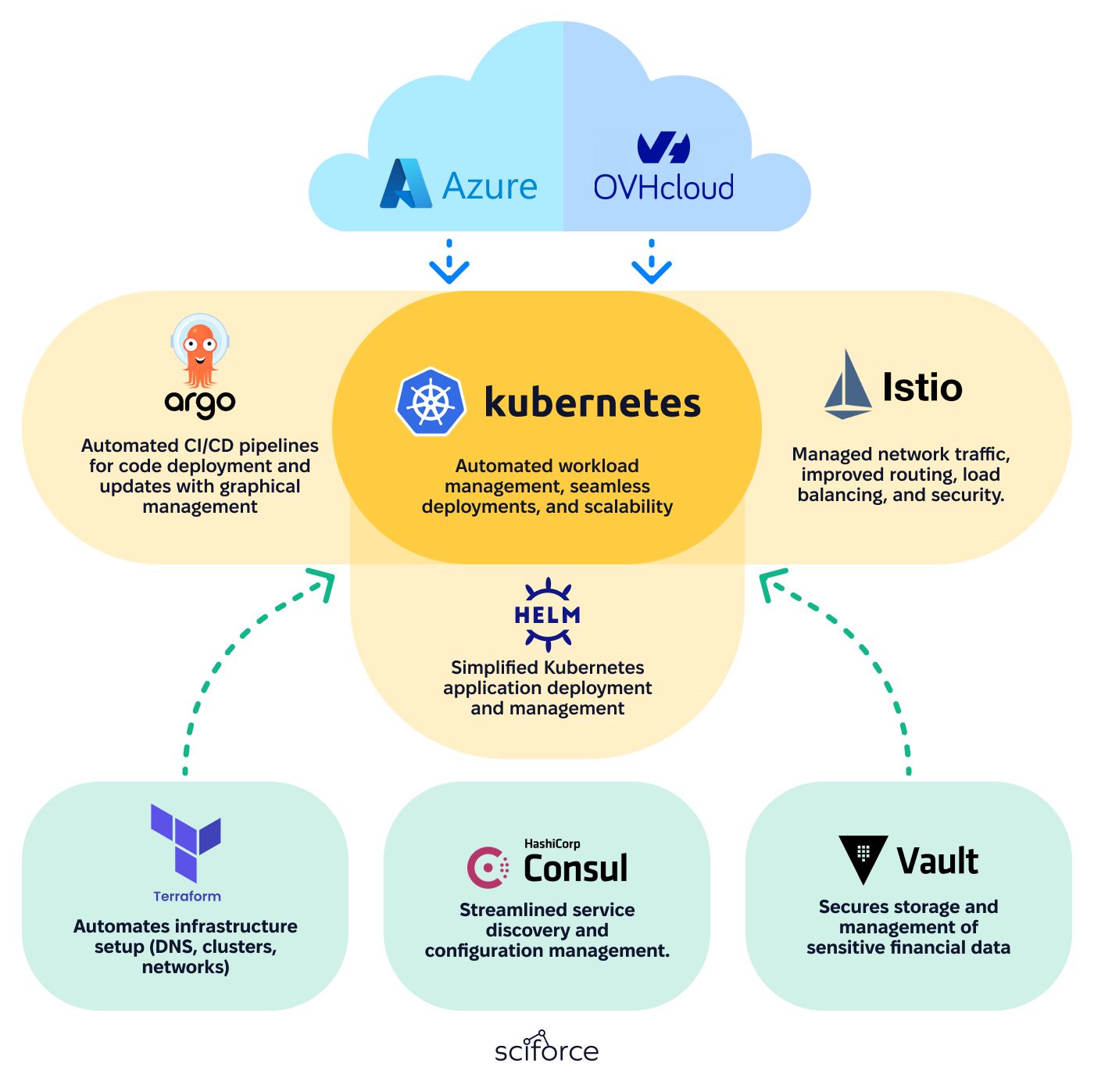
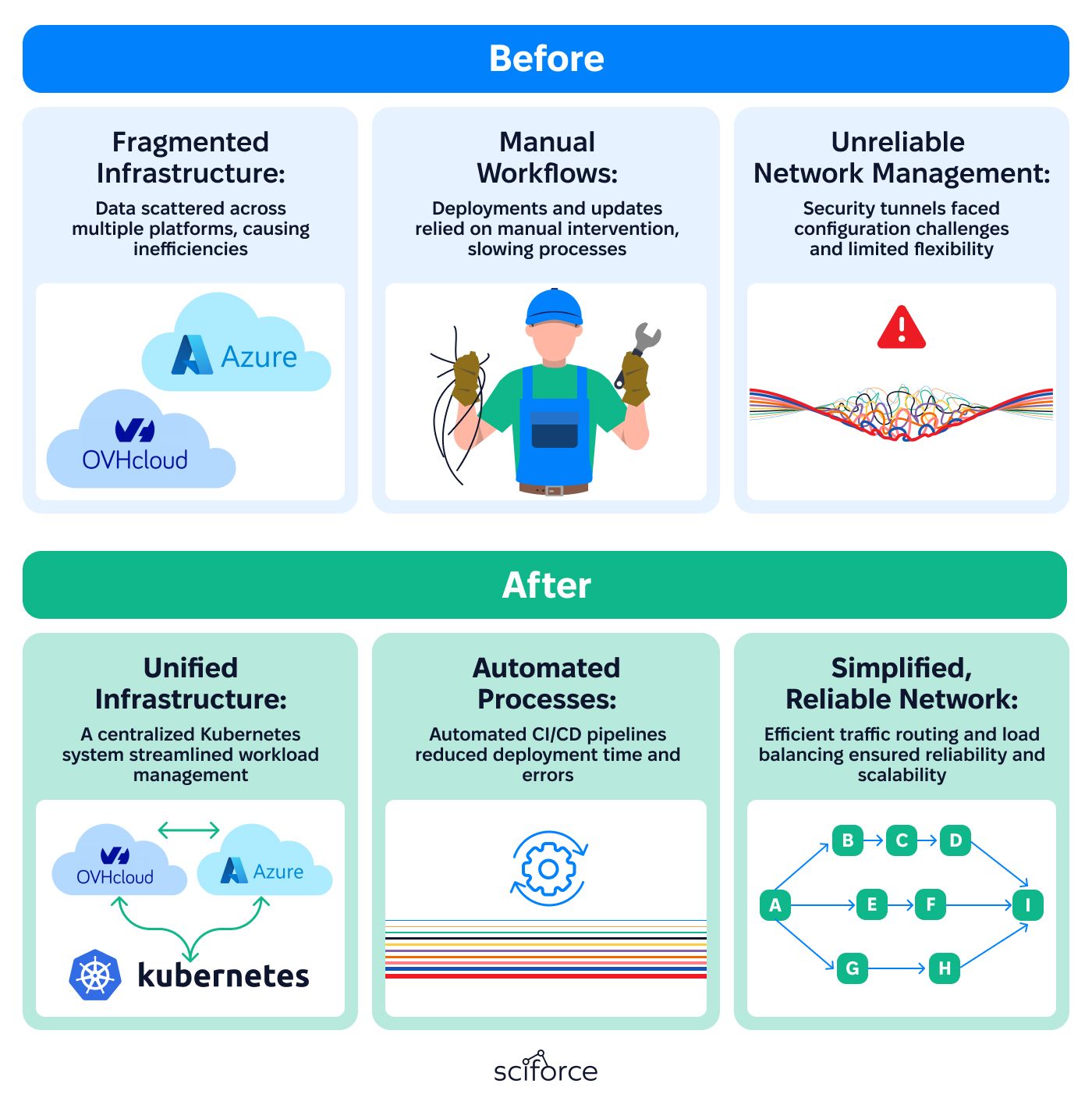
Delivered a fully operational Kubernetes-based system, incorporating secure data pipelines for FinTech with ArgoCD. This modernization improved efficiency and streamlined deployments.
The upgraded infrastructure seamlessly handles production and development workloads, ensuring secure financial data management, storage and transmission through Vault and encrypted communication layers.
Developers now commit code directly to repositories, triggering automated updates in Kubernetes. This financial workflow optimization reduces manual intervention, accelerates deployments, and minimizes errors.
The adoption of a Kubernetes-based service mesh replaced older security tunnels, providing better traffic routing, load balancing, and simplified network configurations.
Workloads were successfully balanced across Azure and OVH multi-cloud setup, maintaining stability and supporting critical business cloud migration strategy for fintech without disrupting operations throughout the migration process.