• Services
    LLM
    AI & ML
    Digital Healthcare
    Data Science
    DevOps
  • Products
    Jackalope
    EyeAI
  • Industries
    Healthcare
    Agriculture
    EdTech / LMS
    Retail / E-commerce
    Manufacturing
  • Resources
    Blog
    Case Studies
    Expert Guides
  • Company
    About us
    Careers
  • Contact us
logo
Services
LLMAI & MLDigital HealthcareData ScienceDevOps
Industries
HealthcareAgricultureEdTech / LMSRetail / E-commerceManufacturing
Case StudiesAbout UsBlogCareers
Our contacts
+380(66)54-32-579
sales@sciforce.tech

Get monthly digest of innovations

This site is protected by reCAPTCHA and the Google Privacy Policy and Terms of Service apply.
Social Media:
Privacy Policy © 2026 Sciforce
5.0
Automated Orchestration of Observational Research cover

Automated Orchestration of Observational Research

Published: January 16, 2025
# Healthcare
# Big Data
# Data Science
# DevOps
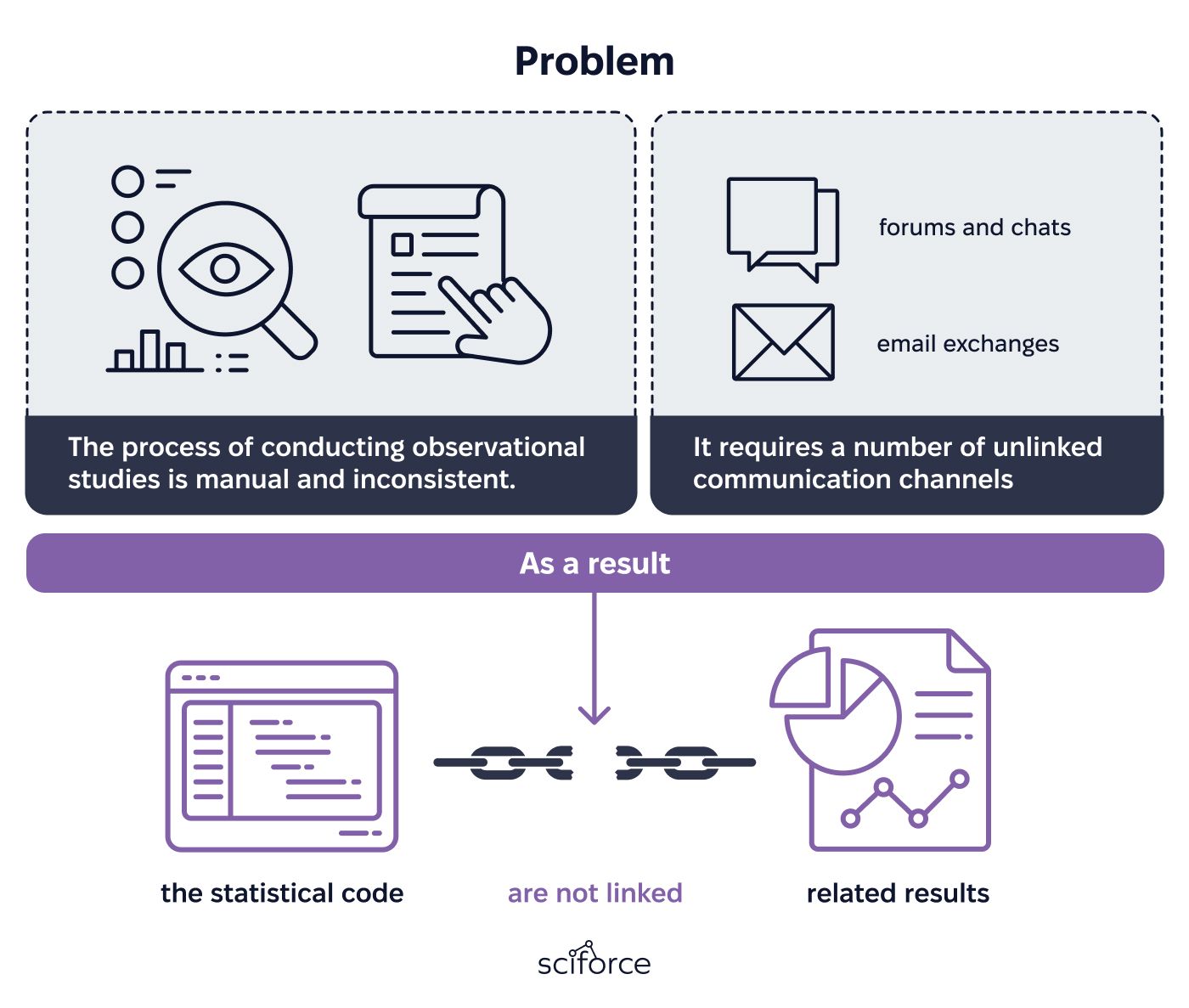
Large data volumes are revolutionizing industries, including AI in medical research. This influx of data enables observational studies that harness global statistical evidence for real-world evidence generation. However, conducting such studies can be labor-intensive and prone to inconsistencies in health data standardization due to disconnected communication channels, like repositories, emails, forums, and chats. Moreover, adapting code to different environments during the execution phase can create unscalable and non-reusable analytical frameworks, while the lack of a secure data exchange platform further complicates collaboration. In response, the OHDSI community is developing ARACHNE, a DevOps-enabled research analytics platform for life sciences and an innovative real-world data (RWD) platform for automated orchestration of observational healthcare research across distributed research networks in life sciences, healthcare, academia, and organizations handling patient-level data

Challenge

01_AO.jpg

Use Case Ready For Generative AI

Find out more with SciForce free checklist

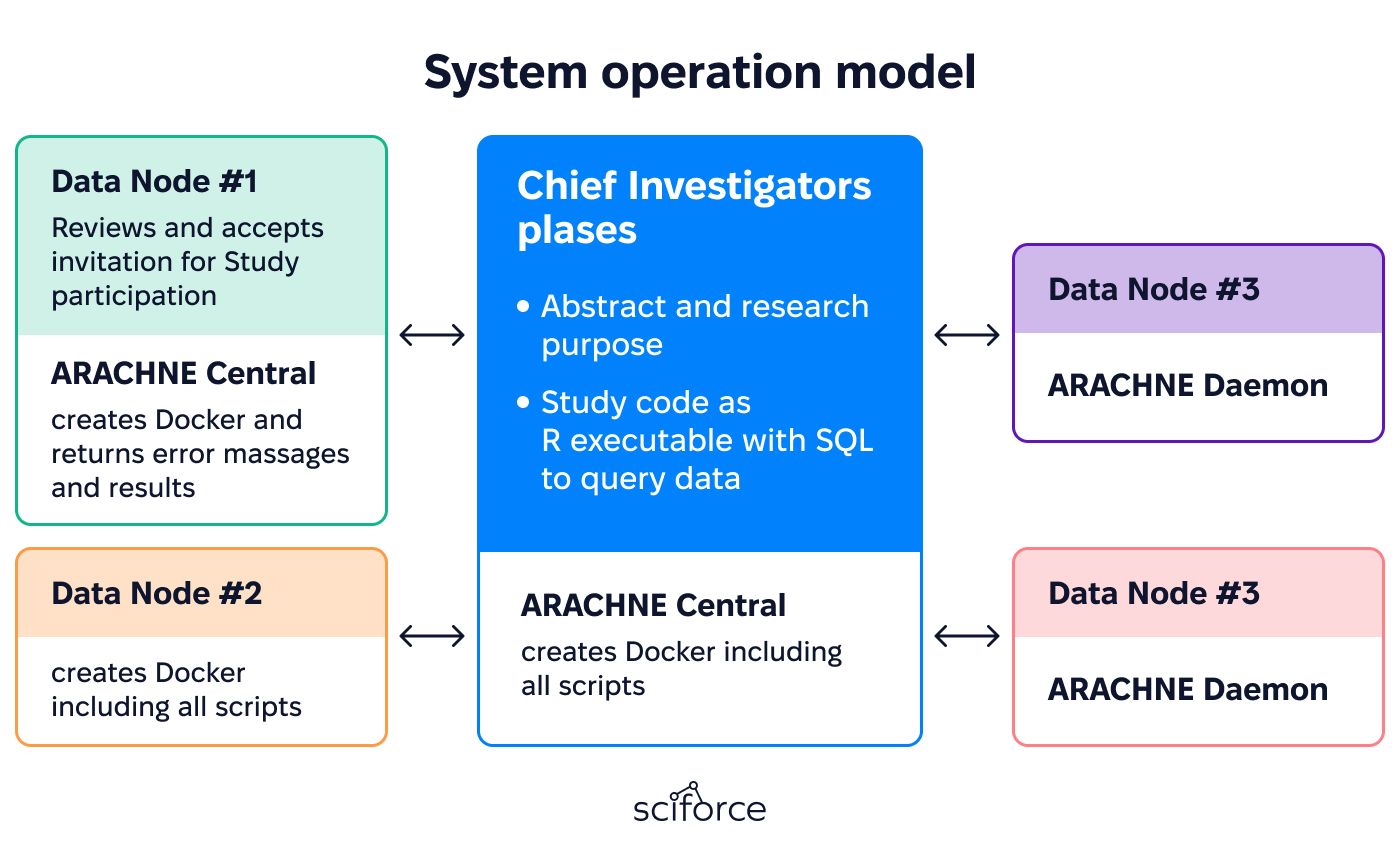
As a partner in several projects with OHDSI, our team played an instrumental role in the development of the Arachne Collaboration Network, a platform designed to facilitate the execution of federated data analysis, also known as Real-World Evidence. Sciforce's contributions included shaping the platform's architecture, overseeing both backend and frontend programming, and implementing fundamental DevOps practices.

Solution

02_AO.jpg

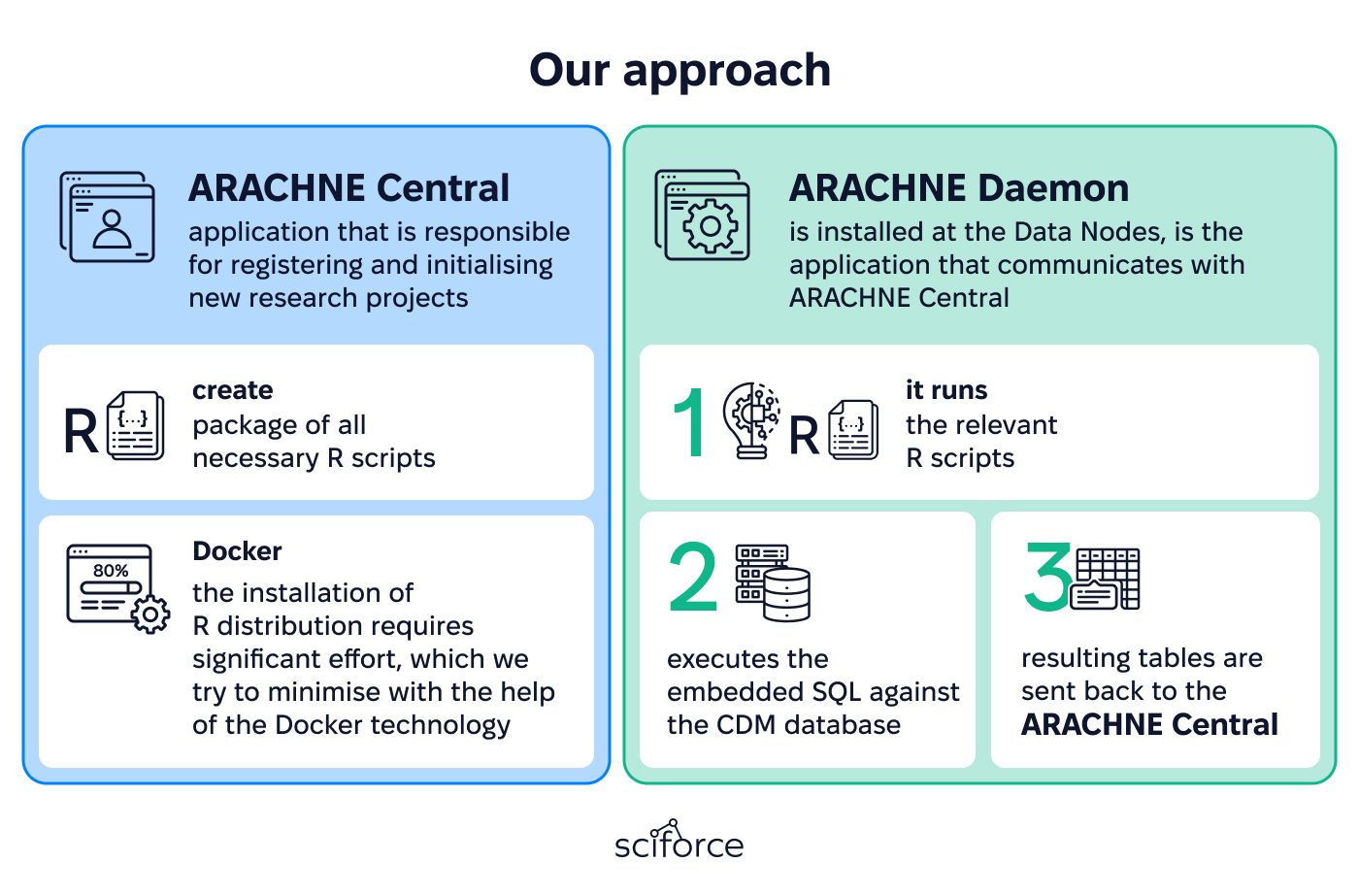
We assumed that ARACHNE should automate observational studies and evidence generation through distributed research studies, serving as an automation framework for OHDSI and OMOP CDM studies. Our implementation is divided into two software applications:

ARACHNE Central

  • Registers and initializes new research projects.
  • Creates packages with necessary R scripts for each project.
  • Uses Docker to simplify R distribution installation by wrapping software with all necessary components, ensuring smooth execution regardless of environment. Orchestrating isolated environments across multiple nodes is a challenge we tackled at a different scale in our multitenant virtual datacenter, where Kubernetes automated the full lifecycle of tenant clusters with strict resource and network isolation.

ARACHNE Daemon

  • Installed at Data Nodes, communicates with ARACHNE Central.
  • Runs relevant R scripts and executes embedded SQL against the CDM database.
  • Sends resulting tables back to ARACHNE Central.
  • Enables distributed execution of OMOP-based observational studies.

03_AO.jpg

Development Journey

04_AO.jpg

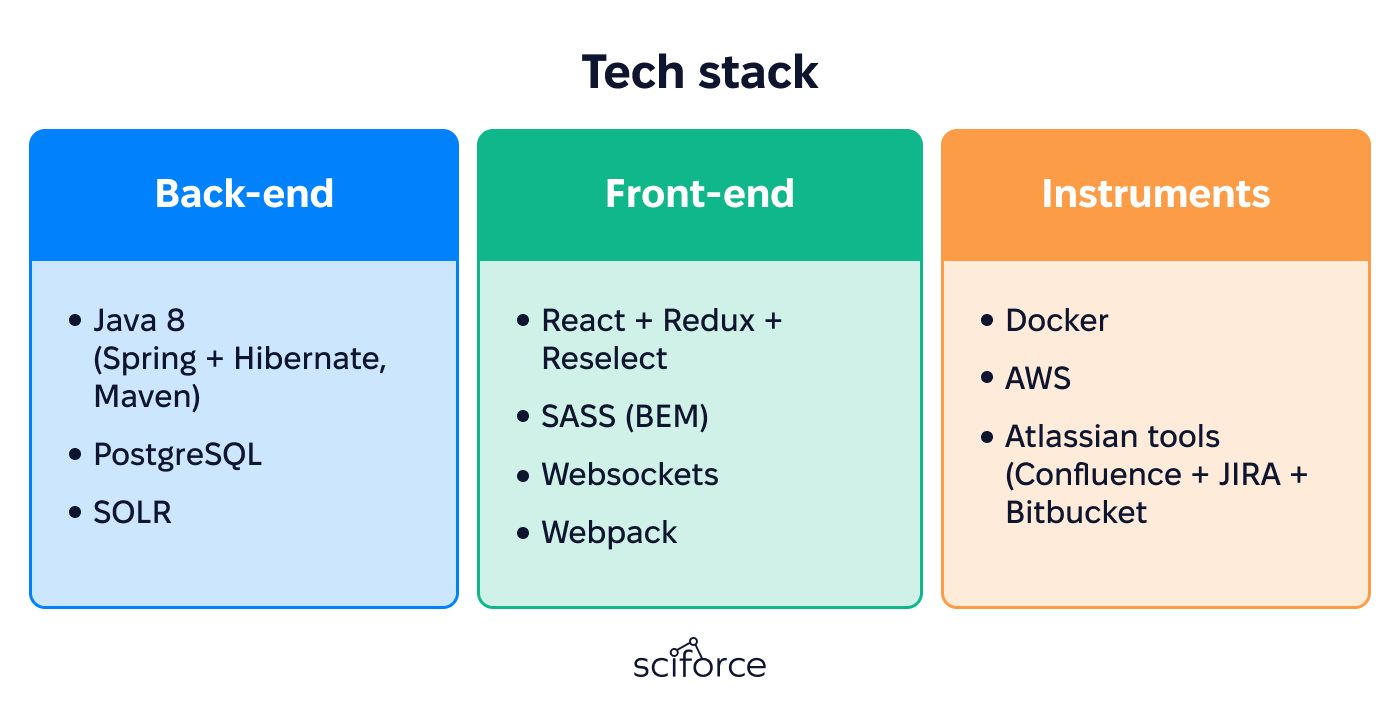
Back-end

  • Language: Java 8
  • Framework: Spring (used Boot for auto deployment and Security for authorization/access management)
  • ORM: Hibernate (simplifies data access with object-relational mapping)
  • Database: PostgreSQL (for user data)
  • Search Engine: SOLR (for advanced search capabilities)
  • Build Tool: Maven (for dependency management and project build)

Front-end

  • Libraries: React + Redux + Reselect
  • Styling: SASS (using BEM methodology)
  • Communication: Websockets (for real-time data transfer)
  • Bundling: Webpack (for module bundling and asset optimization)

Tools

  • Containerization: Docker (for R script isolation and ease of deployment). How those two combine into a fully automated deployment pipeline is shown in our Amazon ECS case, where containerized services are provisioned and updated entirely through Infrastructure as Code
  • Cloud: AWS (for scalable infrastructure)
  • Project Management: Atlassian tools (Confluence for documentation, JIRA for task tracking, Bitbucket for version control)

Data Storage

  • Big Data: Apache Cassandra (for storing research results)

Impact

We built the main part of the front-end app and its user interface, along with a file storage system. We also added features for faster communication and organized data-driven healthcare insights and multi-user support. Our work helped create a multi-user healthcare research network that makes enabling clinical research automation at scale more straightforward, transparent, and secure. It connects everyone involved in the research process, from those providing scalable real-world data analytics to the people analyzing it, for a smooth end-to-end study.


RELATED CASE STUDIES

View all Case Studies
Computable Phenotyping Using OMOP And Human-Governed LLM Assistance

Our client was a U.S.-based, multi-institutional healthcare research initiative developing an AI-ready clinical data ecosystem for critical-care research. The initiative brought together several institutional data sources with differences in clinical workflows, source systems, coding practices, data availability, and OMOP ETL implementations. The client needed a systematic way to translate complex clinical research questions into reproducible computable phenotypes that could support cohort discovery, population characterization, outcome definition, and downstream analytical and machine-learning workflows. The project focused on structured electronic health record data represented primarily through the OMOP Condition, Procedure, Measurement, Observation, Device, Drug, Specimen and Visit domains. To preserve confidentiality, the organization and individual clinical use cases are not disclosed.

# Healthcare
# Data Science
# LLM
End-to-End ETL on Snowflake cover smallFrom Raw Claims and Clinical Data to PCORnet CDM: End-to-End ETL on Snowflake

Our client, a U.S. health insurer collaborating with multiple hospital systems, aimed to aggregate and harmonize anonymized claims and clinical data in the PCORnet Common Data Model (CDM) to support large-scale outcomes research and operational analytics. The incoming medical and billing feeds came from heterogeneous hospital and payer systems with inconsistent schemas, variable data quality, and no unified governance. The client asked SciForce to design and implement a sustainable, cloud-native ETL/ELT pipeline on Snowflake that would: 1) Continuously integrate raw source feeds into a centralized Snowflake data platform; 2) Transform them into a PCORnet-conformant CDM with strong data quality guarantees; 3) Enable near real-time analytics for patient demand forecasting, capacity planning, and revenue cycle optimization.

# Healthcare
# AI / ML
# Big Data
# Data Science
Sensor-Based Fall Detection and Monitoring for Patient SafetyReal-Time Fall Detection System for Elderly Care Facilities

The client was a residential care facility for elderly patients who were at risk of falling, relying on wearable sensor fall detection for assisted living facilities to reduce incidents and response time. Each resident wore a small motion-tracking device as part of a wearable health monitoring setup that measured their movements in three directions. Their rooms were also equipped with AI in assisted living facilities that monitored temperature, humidity, light, noise levels, and whether someone was in or out of bed. The goal was to build an AI fall detection system that could automatically detect when someone had fallen and notify staff quickly. The team focused on understanding how movement patterns could indicate a fall and explored how room data could help add context in the future.

# Healthcare
# Tech
# AI / ML
# Big Data
# Data Science
OMOP to FHIR Conversion: Scalable Healthcare Data PipelineAutomating Research-to-Care Data Integration via OMOP and FHIR

Our client is a university hospital based in Germany, aimed to enhance cross-institutional standardized healthcare data exchange through structured health data pipelines. Multiple institutions involved in observational research sought integrating observational research data into clinical systems via FHIR, including risk models and disease prevalence metrics, into operational clinical workflows. To support this goal, the client required a conversion pipeline from OMOP CDM (used in research analytics) to HL7 FHIR (used in clinical applications) to enable real-time data AI for healthcare data interoperability.

# Healthcare
# AI / ML
# Big Data
# Data Science