
• Services
    LLM
    AI & ML
    Digital Healthcare
    Data Science
    DevOps
  • Products
    Jackalope
    EyeAI
  • Industries
    Healthcare
    Agriculture
    EdTech / LMS
    Retail / E-commerce
    Manufacturing
  • Resources
    Blog
    Case Studies
    Expert Guides
  • Company
    About us
    Careers
  • Contact us
logo
Services
LLMAI & MLDigital HealthcareData ScienceDevOps
Industries
HealthcareAgricultureEdTech / LMSRetail / E-commerceManufacturing
Case StudiesAbout UsBlogCareers
Our contacts
+380(66)54-32-579
sales@sciforce.tech

Get monthly digest of innovations

This site is protected by reCAPTCHA and the Google Privacy Policy and Terms of Service apply.
Social Media:
Privacy Policy © 2026 Sciforce
5.0
Emerging Trends and Use Cases of Industry-Specific LLM Applications cover

Emerging Trends and Use Cases of Industry-Specific LLM Applications

Published: March 27, 2025
# AI / ML
# NLP
# LLM

Large Language Models (LLMs) are changing how businesses work, turning complex processes into faster, smarter, and more efficient operations. These AI models can write, analyze, and process massive amounts of text in ways that once required hours of human effort.

2026 Generative AI Opportunity Map: Where Each Industry Wins (and Risks Losing)

Find out more with SciForce free whitepaper

Companies are using them to power customer support, generate content, analyze financial risks, and even assist with software development – all with greater speed and precision. For many, enterprise LLM integration is becoming a core strategy for scaling operations without sacrificing quality.

This article explores how businesses are applying LLMs to improve everyday operations, enhance decision-making, and solve complex problems. It also examines key challenges such as data privacy, accuracy, and compliance, along with the trends shaping their future.

Understanding Large Language Models (LLMs)

Large Language Models (LLMs) are AI systems trained on vast text datasets to process and generate human-like language. Using deep learning—particularly Transformer architecture—they understand context, summarize information, translate languages, generate content, and assist with coding. Unlike rule-based systems, LLMs adapt dynamically, making them highly versatile for business applications.

These models power a wide range of tools, from virtual assistants and customer support chatbots to AI for business automation, financial analysis, and legal document processing. LLMs help businesses automate tasks, extract insights from unstructured data, and improve decision-making efficiency.

Several of the best LLMs for enterprise are leading the way in business applications, each with unique strengths tailored to different industries:

  • GPT-4 (OpenAI) – A general-purpose model used for content creation, chatbots, code generation, and research.
  • LLaMA (Meta) – An open-source model designed for enterprise AI applications, offering businesses more customization and control.
  • BloombergGPT – A finance-focused LLM trained specifically for market analysis, financial reporting, and investment research.
  • Med-PaLM (Google DeepMind) – A healthcare-specialized LLM optimized for medical queries, clinical documentation, and summarizing medical research. These models demonstrate how LLMs are becoming more specialized, allowing businesses to deploy AI that is fine-tuned for their specific needs and explore diverse generative AI use cases.

Future Trends in LLM Adoption

Advancements in AI are making LLMs more specialized, multimodal, efficient, and collaborative, expanding their business applications.

  • Specialized Domain Models: Industry-specific LLMs (e.g., MedGPT for healthcare, LegalGPT for law) provide more accurate and relevant insights while reducing errors. The current state of that specialization across healthcare, finance, legal, and retail is mapped out in the industry-specific LLM applications article.
  • Multimodal AI: Future LLMs will process text, images, video, and audio, allowing businesses to analyze schematics, optimize retail experiences, and integrate AI with simulation tools.
  • Expanded Context and Memory: AI assistants will handle longer documents, retain user preferences, and support continuous interactions, improving personalization and workflow continuity.
  • Improved Efficiency and Accessibility: Lighter AI models will enable on-device processing, reducing hardware costs, improving security, and making AI more accessible for small businesses.
  • AI Collaboration and Autonomous Agents: Multi-agent AI systems will coordinate multiple tasks, integrating LLMs into enterprise workflows for dynamic execution and process automation.

LLMs are becoming more than content generators – they are intelligent tools that enhance expertise, improve decision-making, and fuel innovation. Businesses that invest in AI-enhanced decision-making will stay ahead in an increasingly AI-powered world.

LLM-Powered Business Functions Across Industries

LLMs are transforming industries by automating tasks, improving decision-making, and enhancing customer experiences. Businesses from different industries use AI to work more efficiently, cut costs, and gain valuable insights, leading to better productivity and smarter services.

EdTech – Content Creation & Personalization

LLMs are making education more accessible by personalizing learning, automating teacher tasks, and improving student support. AI tutors adapt to learning styles, adjust difficulty, and offer real-time hints or explanations. By analyzing student responses, LLMs tailor lessons, deliver instant feedback, and assist educators with routine tasks.

  • Automated Content Generation: Creates lesson plans, quizzes, and summaries tailored to skill levels, saving preparation time
  • Administrative Support: Handles routine tasks so teachers can focus on teaching.
  • AI-Assisted Grading & Feedback: Delivers instant, consistent feedback, reducing bias and freeing up educators.
  • Enhanced Accessibility: Translates content, simplifies texts, and provides 24/7 assistance for diverse learners.

When used with oversight, LLMs help educators deliver customized, engaging instruction without replacing human guidance.

ERP – Business Process Automation & Decision Support

Enterprise Resource Planning (ERP) systems manage core business functions like finance, HR, and supply chain. Integrating LLMs makes these systems more intuitive and intelligent. For example, EY invested $1.4B in an AI platform and deployed a private LLM (EYQ) to 400,000 employees, reporting a 40% productivity boost – expected to reach 100% within a year.

By adding a natural language interface, employees can access and interact with enterprise data simply by asking questions. LLM-powered ERP systems can:

  • Automate Data Processing – LLMs extract key info from emails, invoices, and tickets, automatically updating ERP systems for faster, more accurate workflows.
  • Provide AI-powered employee self-service – Employees request tasks like vacation booking or inventory checks via AI chatbots with instant responses.
  • Generate Instant Reports – Managers get quick access to sales, project, or financial reports through AI-driven summaries of ERP data.
  • Enable Voice-Activated Business Intelligence – Executives use voice commands to retrieve real-time insights like forecasts or delivery status.

LLMs reduce time spent on data entry, freeing employees for higher-value analysis and decisions, and can be combined with AI automation tools for further streamlining of ERP workflows. Faster insights boost agility, while AI-powered search helps new team members access information quickly without relying on experts.

Finance – Predictive Analytics & Risk Management

Modern financial chatbots now handle complex, nuanced questions across multiple languages, boosting accessibility and customer support. The finance industry has rapidly adopted LLMs for tasks like forecasting, risk analysis, and compliance due to their ability to process vast amounts of structured and unstructured data. Studies show GPT-4 achieves 60% forecasting accuracy, outperforming human analysts, which supports better investment decisions and operational efficiency.

  • 24/7 Customer Support: LLM-powered chatbots manage account inquiries, loans, and transactions across languages, easing call center workloads and improving response times.
  • Fraud & Risk Monitoring: AI analyzes transactions and unstructured data to detect scams and anomalies in real time, enhancing fraud prevention.
  • Credit & Market Risk Assessment: LLMs assess borrower profiles and summarize market data to support better lending and trading decisions.
  • AI-Driven Financial Advisory: AI drafts personalized investment recommendations, helping wealth advisors scale insights efficiently.
  • Regulatory Reporting Automation: LLMs track transactions, interpret regulations, and generate compliance reports, cutting penalties and admin costs.

Naturally, finance has strict requirements around security, transparency, and oversight. To ensure trust and accuracy, AI-generated financial insights undergo human validation, strict compliance monitoring, and bias detection in lending and investment decisions.

Retail & E-Commerce – Personalization & Intelligent Automation

Retail is being reshaped by LLMs, which enhance customer experiences, streamline operations, and boost marketing efficiency. According to McKinsey, generative AI could add $240–$390 billion in annual value to the sector, raising profit margins by up to 1.9 percentage points. As adoption grows, retailers are integrating LLMs across key business functions.

  • AI-Powered Personalization: LLMs analyze customer behavior to deliver tailored product suggestions and promotions, boosting satisfaction and reducing support costs.
  • Virtual Customer Support: AI assistants handle inquiries, returns, and inventory checks, improving response speed and enabling upselling through intent recognition.
  • Dynamic Pricing & Sentiment Analysis: AI adjusts prices in real time based on market data and consumer sentiment, optimizing revenue and timing of discounts.
  • Inventory & Demand Forecasting: LLMs predict demand using trends and external data, automating restocks and minimizing stock imbalances.
  • Automated Content & SEO: AI generates product content at scale and supports marketing across channels with optimized, consistent messaging.

In retail, LLMs go beyond automation – they refine interactions, anticipate needs, and adapt to context. By enhancing customer engagement, inventory planning, and marketing precision, they help deliver the right product, at the right price, to the right customer – at scale.

Healthcare – AI-Powered Intelligence & Assistance

Healthcare is increasingly using LLMs to streamline workflows, improve patient communication, and support research. Trained on clinical literature, specialized healthcare models help doctors and researchers reduce admin tasks, synthesize information, and enhance decision-making – all with human oversight.

  • Workflow Automation: LLMs transcribe notes, generate visit summaries and billing codes, reducing physicians' admin burden.
  • Diagnostic & Research Support: AI quickly identifies diagnoses and treatment options by analyzing clinical data and literature.
  • Patient Interaction: Chatbots handle scheduling, symptom checks, and simplify medical language to improve care adherence.
  • Drug Safety Monitoring: AI tracks literature and feedback to flag early signs of adverse drug effects.
  • Study Summarization: LLMs condense research and translate findings into accessible formats for faster knowledge sharing.

LLMs are becoming AI “co-pilots” in healthcare – supporting treatment plans, documentation, and clinical decisions while keeping doctors in control. With the right governance, healthcare LLM applications streamline workflows, surface insights from data, and enhance patient communication, making care more efficient and supportive.

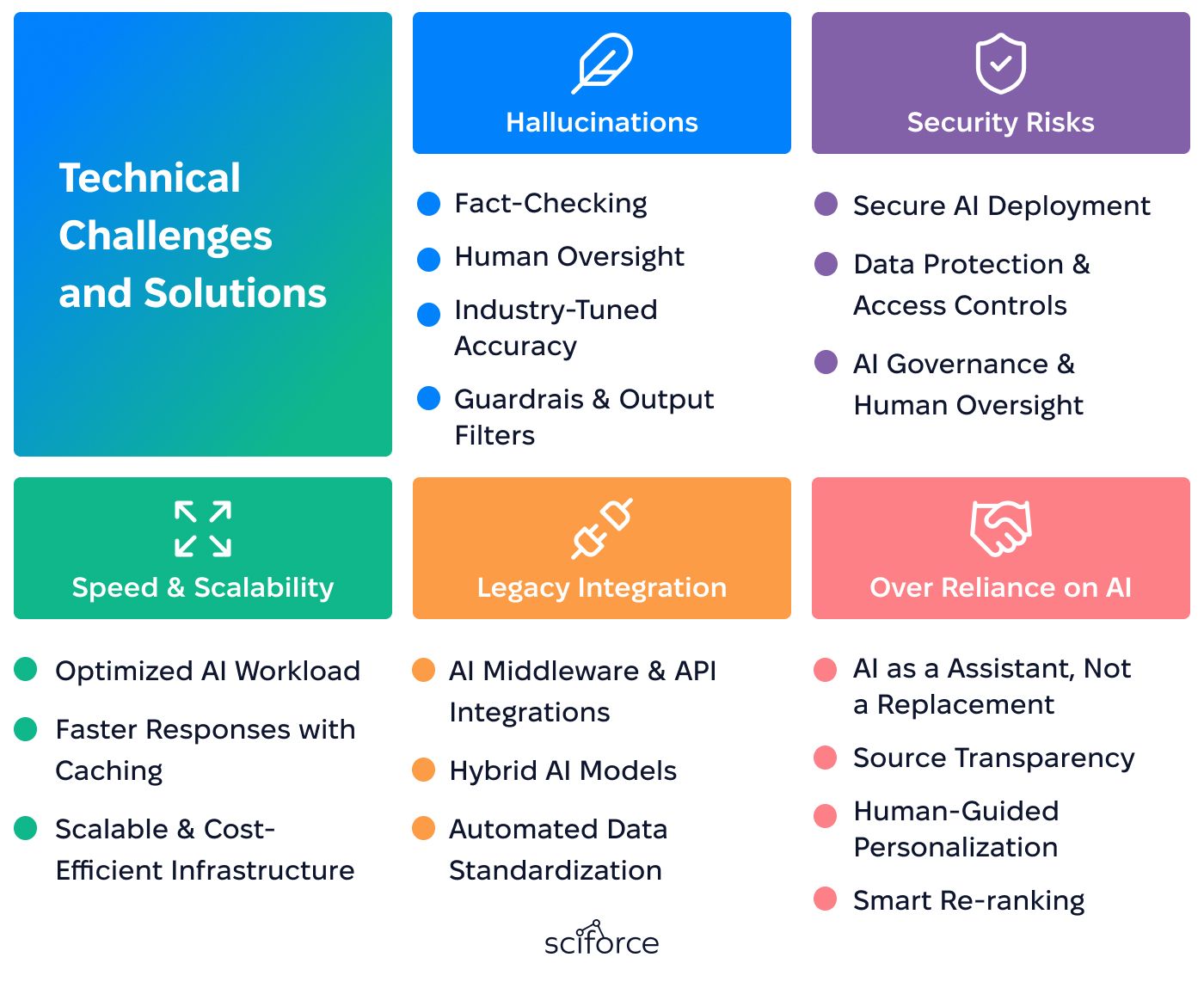
Technical Challenges and Solutions

While LLMs offer powerful capabilities across industries, their adoption comes with technical and operational hurdles. Ensuring accuracy, security, and compliance requires organizations to implement robust strategies for mitigating risks and optimizing performance.
01 (4).jpg

Preventing LLM Hallucinations

Incorrect but plausible AI responses can lead to financial and compliance risks, especially in sensitive areas like fraud detection or reporting. Hallucinations often stem from outdated knowledge, unsupported extrapolations, or ambiguous queries. At SciForce, we mitigate hallucinations in high-stakes domains like finance by combining real-time data access, model tuning, and strict output controls:

  • Retrieval-Augmented Generation (RAG): Ensures real-time data grounding from trusted financial sources.
  • Human Oversight & Risk Scoring: Flags uncertain outputs for review instead of automated action.
  • Domain Fine-Tuning & Traceability: Aligns responses with financial standards using proprietary data and cited sources.
  • Guardrails & Output Filters: Prevent speculative or non-compliant responses in critical use cases.

Protecting Sensitive Information

AI in healthcare must comply with HIPAA/GDPR while supporting clinical decisions. Risks include data leaks, unauthorized access, and inappropriate AI influence on medical decisions. At SciForce, we build healthcare AI solutions that prioritize patient privacy and regulatory compliance with AI without compromising clinical support.

  • Private Cloud Deployment: Keeps data within hospital infrastructure, avoiding third-party exposure.
  • Anonymization & Access Controls: Encrypts data and limits AI access to verified clinical roles.
  • Governance & Logging: Tracks all outputs with audit trails and validation checkpoints to ensure accountability.

Speed & Scalability with Customers

High volumes of customer queries can overwhelm AI systems, increasing costs and response delays during peak traffic. At SciForce, we design AI solutions that stay fast and cost-efficient – even under peak traffic.

  • Tiered Processing: We separate routine queries from complex ones, using lightweight systems for speed and LLMs only when needed.
  • Edge Caching: Frequently asked questions are answered instantly from local storage, cutting down AI load.
  • Elastic Infrastructure: Our serverless setups auto-scale with demand, keeping performance high and costs controlled.

Integration with Legacy Systems

Older ERP/CRM platforms lack native AI support, complicating integration and insight delivery. At SciForce, we help clients modernize without overhauling – bringing AI into decades-old ERP, CRM, and supply chain systems.

  • Modular API Middleware: We connect LLMs to legacy platforms using lightweight APIs: no major code rewrites needed.
  • Hybrid AI Models: Our solutions combine LLMs with structured enterprise data for accurate, real-time forecasting and decision support.
  • Automated Data Cleanup: We build pipelines that clean and normalize historical data, turning messy inputs into usable insights.

Balancing AI Assistance Without Overreliance

Too much automation can dilute teaching quality and student engagement if AI-generated content lacks oversight. At SciForce, we design AI tools that support educators, not replace them – ensuring quality, accuracy, and meaningful learning outcomes.

  • Human-in-the-Loop Design: We build systems where educators review and customize AI-generated lessons, maintaining control over content.
  • Content Verification: AI outputs are cross-checked against reliable academic sources to prevent misinformation.
  • Smart Re-Ranking: We implement re-rankers that prioritize clarity, relevance, and educational value before anything reaches students.

The key in successful AI integration to any business is strategic implementation: combining automation with human validation, ensuring transparency, and aligning AI with existing workflows.

SciForce LLM Expertise

SciForce has worked with businesses across industries to integrate AI solutions that streamline operations, improve decision-making, and automate complex tasks. These case studies show how our expertise in LLM-powered systems has enhanced knowledge management, data processing, and language learning.
Enterprise Knowledge Assistant

01.jpg

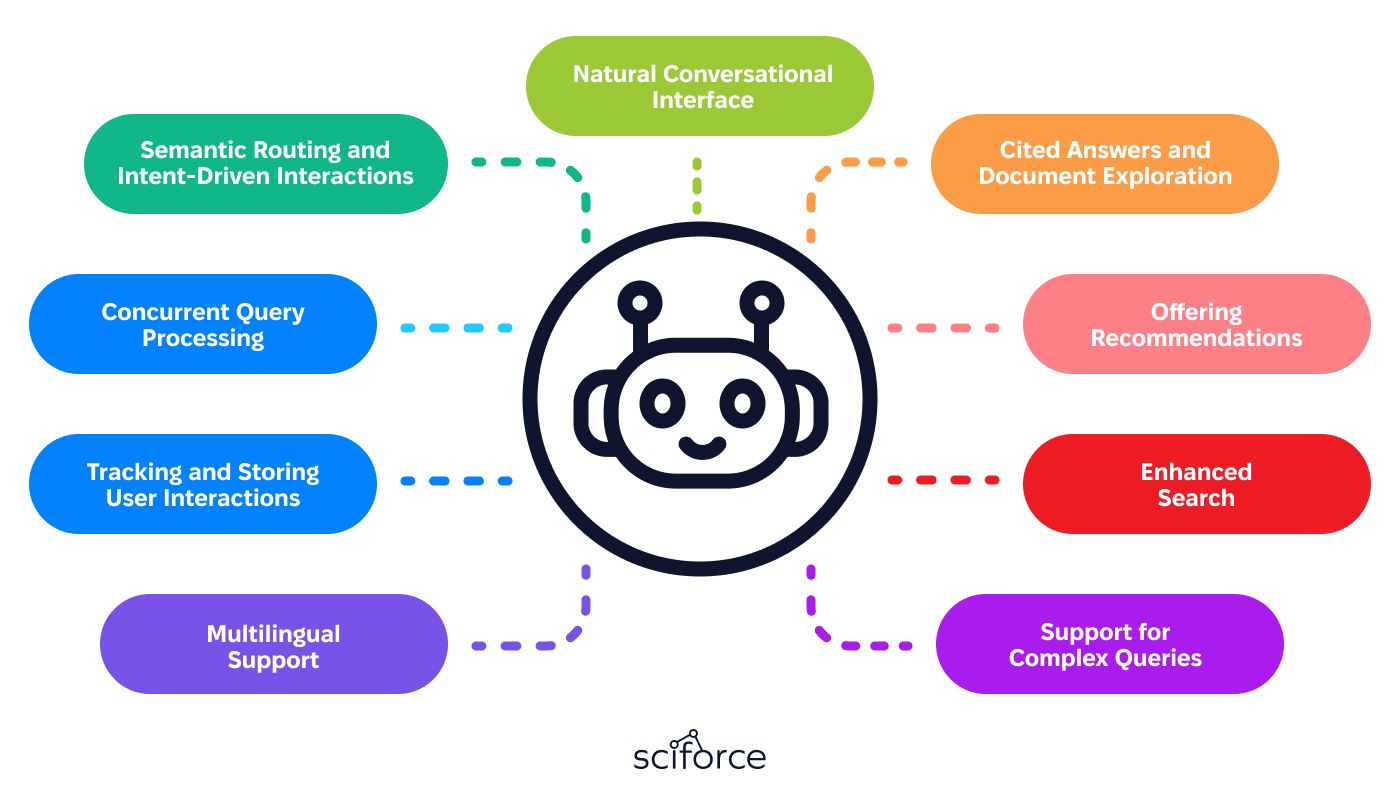
A leading ERP provider needed an AI-powered assistant to deliver fast, accurate answers to product-related queries while reducing support team load. The assistant had to respond in under two seconds, accurately handle complex industry-specific questions regarding client’s services, and integrate with internal documentation (including presentations, PDFs and FAQs).

Solution & Implementation

To meet the client’s goals, we delivered a solution that combines GPT-4o-mini with Qdrant vector search and a FastAPI microservice architecture. This setup enables accurate, real-time responses by converting queries into semantic embeddings and retrieving relevant content from internal knowledge sources, demonstrating the impact of GPT-4 business solutions. The system supports over 100 languages, handles multiple queries simultaneously, and delivers context-aware suggestions – reducing support load while improving user experience.
Results & Impact

  • Faster customer interactions, with response times under 2 seconds.
  • Lower operational costs, reducing support expenses by 25%.
  • Increased automation, handling 78% of customer queries without human intervention.

Enterprise Data Processing Solution

01.jpg

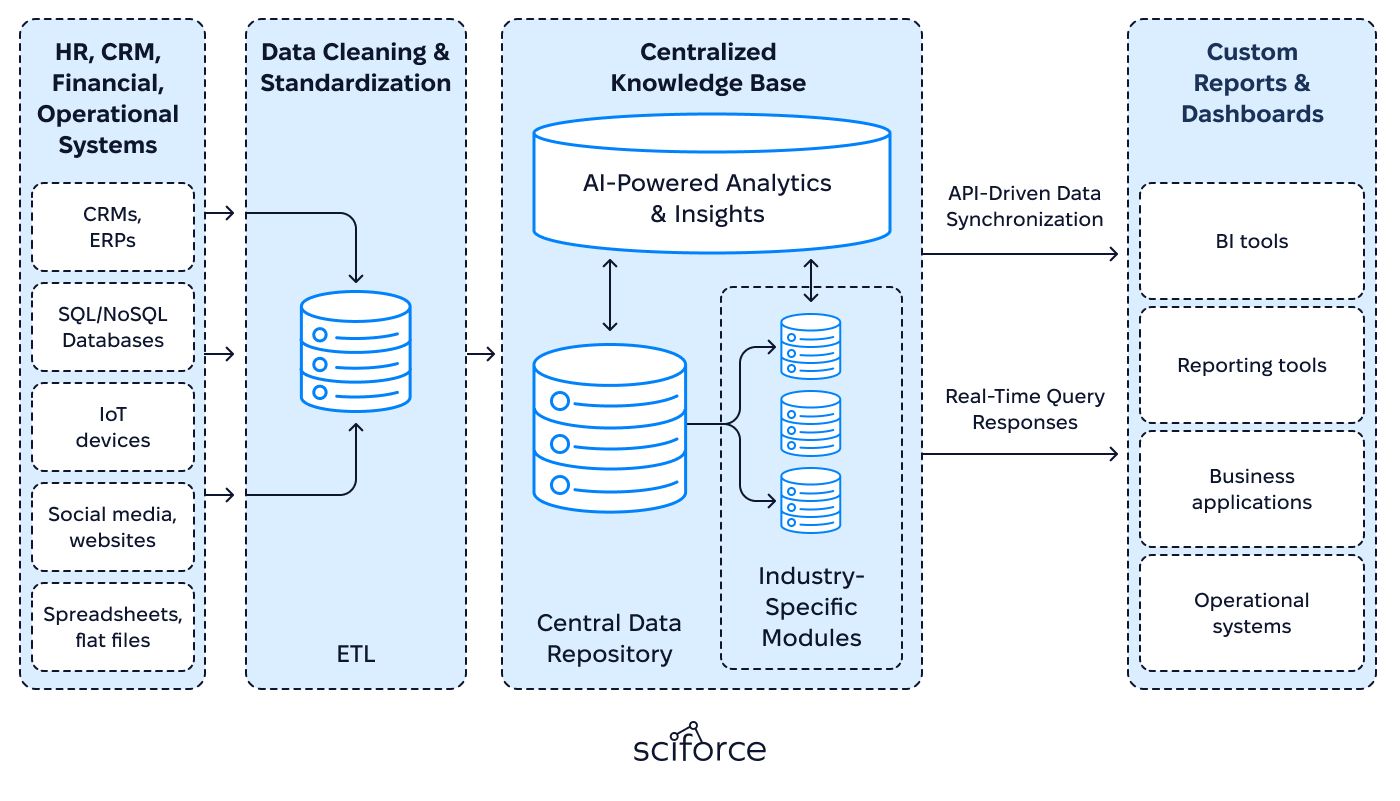
A leading performance management provider needed an AI-driven solution to centralize business metrics and improve decision-making. Their platform combines data from recruitment, sales, operations, and finance to deliver real-time insights, predictive analytics, and natural language access via chatbot. The client asked us to unify fragmented data, optimize response times, ensure high answer accuracy, and embed strong security and compliance safeguards as part of building scalable AI solutions.

Solution & Implementation

We built a scalable AI-driven performance management system using vector search, structured data pipelines, and RAG-powered LLMs. The solution integrates data from HR, CRM, finance, and operations into a centralized reporting hub, supports fast and accurate query handling through hybrid processing, and offers a chatbot for natural language access. Built-in security features, including role-based access and compliance filters, ensure data protection, while customizable analytics deliver real-time insights and forecasting.
Results & Impact

  • Unified metrics cut manual work by 58% and reduced hallucinations by 68%.
  • Hybrid processing lowered LLM usage by 46%, improved response times by 38%, and cut costs by 39%.
  • The AI chatbot shortened dashboard navigation time by 47%.

Language Teaching Assistant

01 (2).jpg

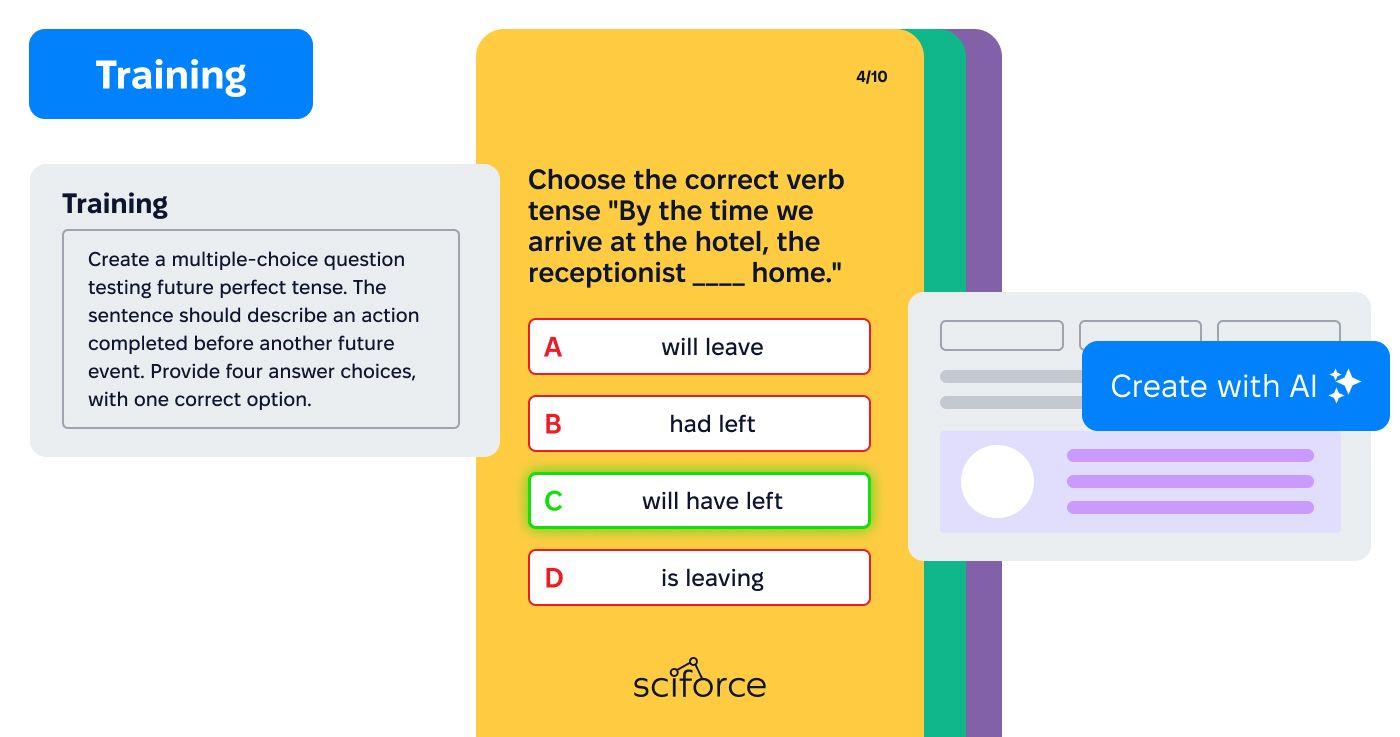
An EdTech language platform focused on delivering personalized learning needed an AI solution to streamline lesson creation, automate assessments, and scale curriculum planning. The goal was to enhance educator efficiency and offer students adaptive, interactive language instruction.

The client needed a solution to reduce manual content work, personalize learning by skill level, scale courses efficiently, and improve engagement with interactive, culturally accurate AI-generated materials.

Solution & Implementation

We developed a robust AI-powered platform for a language learning provider, integrating LLMs, speech recognition, and adaptive learning algorithms. The solution automates lesson and quiz generation, adjusts content to individual student progress, and provides instant feedback on grammar, pronunciation, and fluency. Interactive dialogues, speech synthesis, and educational videos enhance engagement, while LLM security and governance measures ensure safe, compliant learning environments at scale.

Results & Impact

AI automated lesson creation reducing manual work by 60%, freeing up educators for student interaction.

  • Personalized adaptive exercises accelerated student progress by 30%.
  • Interactive dialogues, speech tools, and videos improved engagement by 40%.
  • The platform scaled its course offerings by 3x without increasing operational costs.

Conclusion

LLMs are transforming industries – automating tasks, refining insights, and driving smarter decision-making. Businesses that strategically integrate AI will work faster, scale efficiently, and stay ahead of the competition.

Success lies in balancing automation with human expertise, ensuring security, accuracy, and transparency – a core principle in understanding how to implement LLM in business effectively. The future will belong to companies that work with expert LLM integration services to align AI deployments with strategic goals. Book a consultation with SciForce to explore what LLM can bring to your business.

RELATED BLOG ARTICLES

View all Articles
OHDSI Europe Symposium 2026From OMOP Workflows to Living Evidence: SciForce at OHDSI Europe Symposium 2026

This April, Polina Talapova and Mariia Pahur represented SciForce at the 7th European OHDSI Symposium in Rotterdam – three vivid days of workshops, poster sessions, MindMeetsMachines mapping competition and an oral presentation aboard the SS Rotterdam, a retired ocean liner moored on the Maas river. The symposium's theme was Continuous Collaboration for Living Evidence Generation. The word "living" matters here. Traditional evidence-generation projects are often designed as discrete studies. A

# Healthcare
# AI / ML
# Data Science
# LLM
Telehealth Platform ArchitectureTelehealth Platform Architecture: Building Secure, Scalable Virtual Care Systems

Building a telehealth platform at clinical scale means solving for hospital network restrictions, HIPAA compliance and auditability, and the data load of continuous remote monitoring – and the architecture decisions that determine whether it holds up are mostly made in the first few sprints. The engineering debt from early decisions starts showing up at scale: video sessions dropping when hospital firewalls, restrictive egress policies, or network address translation prevent a direct media path;

# Healthcare
# AI / ML
# Data Science
Improving Diagnostic Accuracy and WorkflowAI in Medical Imaging: From Diagnostic Accuracy to Clinically Usable Workflow

A radiologist on a standard hospital shift may read dozens to well over a hundred imaging studies, depending on subspecialty, setting, shift structure, and case complexity. Each one is a search for something that might be subtle, easy to miss, or buried in noise. At that volume, non-trivial discrepancy or error rate is a known risk in radiology practice, especially under high workload and time pressure. Radiologists are working through growing imaging volumes with a workforce that has never full

# Healthcare
# AI / ML
# Computer Vision
# Data Science
Sustainable AI: Strategies for Managing Compute Costs and Energy EfficiencySustainable AI: Strategies for Managing Compute Costs and Energy Efficiency

In 2025, the world’s data centers consumed 485 terawatt-hour of energy, with AI-related demand growing at 50%. By 2030, the consumption is expected to reach 950 TWh – twice as much as today, and equals approximately the entire electricity consumption of Japan. Goldman Sachs forecasts that about 60% of new demand will be met by burning fossil fuels, increasing global carbon emissions to 220 million tons. And as the chart below shows, the emissions cost escalates sharply with each new generation o

# AI / ML
# Data Science