
Firmware failures don’t stay confined to software. They stop lines, knock out motors, and ruin batches. Once production is down, firmware stops being “just code.” Even so, many manufacturers still treat firmware as a fixed machine component: ship it once, assume it will hold up, and deal with the fallout later.
That approach breaks down fast at scale. Last year, 61% of manufacturers faced unplanned downtime, causing nearly $1 billion in losses. At the same time, the software estate keeps getting larger. With 40 billion IoT devices expected by 2034, the embedded code running inside controllers, vision systems, and gateways is becoming harder to ignore and harder to update safely.
Embedded DevOps is the delivery model for that environment. It gives a disciplined way to release, validate, and support firmware changes across thousands of deployed devices without turning an update into a shutdown.
Embedded systems support jobs where timing slips show up immediately. A servo may correct position 10,000 times each second, and a vision system may reject a defective part in less than a millisecond. That work stays on the device rather than in the cloud because adding network latency or connection loss to the control path is unacceptable.
That local processing follows a continuous on-device cycle: sensors capture physical conditions such as position, speed, temperature, and current, and a processor (an MCU or MPU) runs the embedded software, typically on an RTOS or Linux. The control logic then checks those readings against rules, setpoints, and safety limits, and actuators such as motors, valves, and relays execute the resulting command.
The cycle repeats hundreds or thousands of times per second. That’s why predictable timing matters more here than in almost any other software.
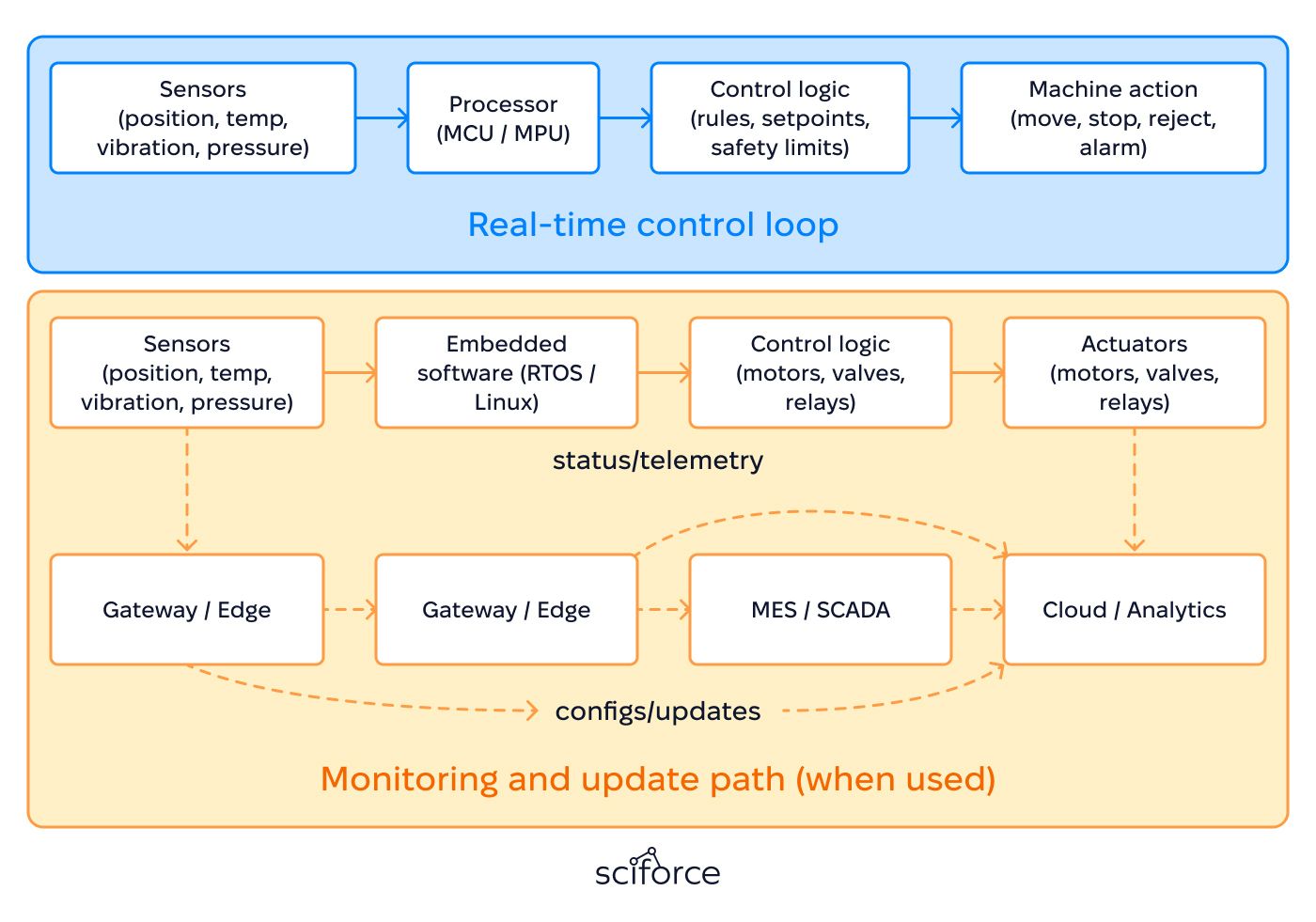
Alongside the control loop, most plants run a second path for telemetry, diagnostics, and configuration. It touches every piece of equipment on the line: controllers, vision cameras, drives, AGVs, and condition monitoring nodes. Data flows upward through a gateway or edge layer into a stack of higher-level systems, each at a different scope and timescale.
At the shop floor, SCADA handles live monitoring and alarms — the operator's window into what the line is doing right now. One layer up, MES connects that real-time picture to production execution: work orders, quality records, traceability. Above that, cloud or analytics platforms collect data across sites for fleet-level monitoring and remote service.
The devices feeding this stack range from small microcontrollers handling a single control task to Linux-based edge computers running machine vision or on-device AI. That range matters because any update process has to work across all of it.
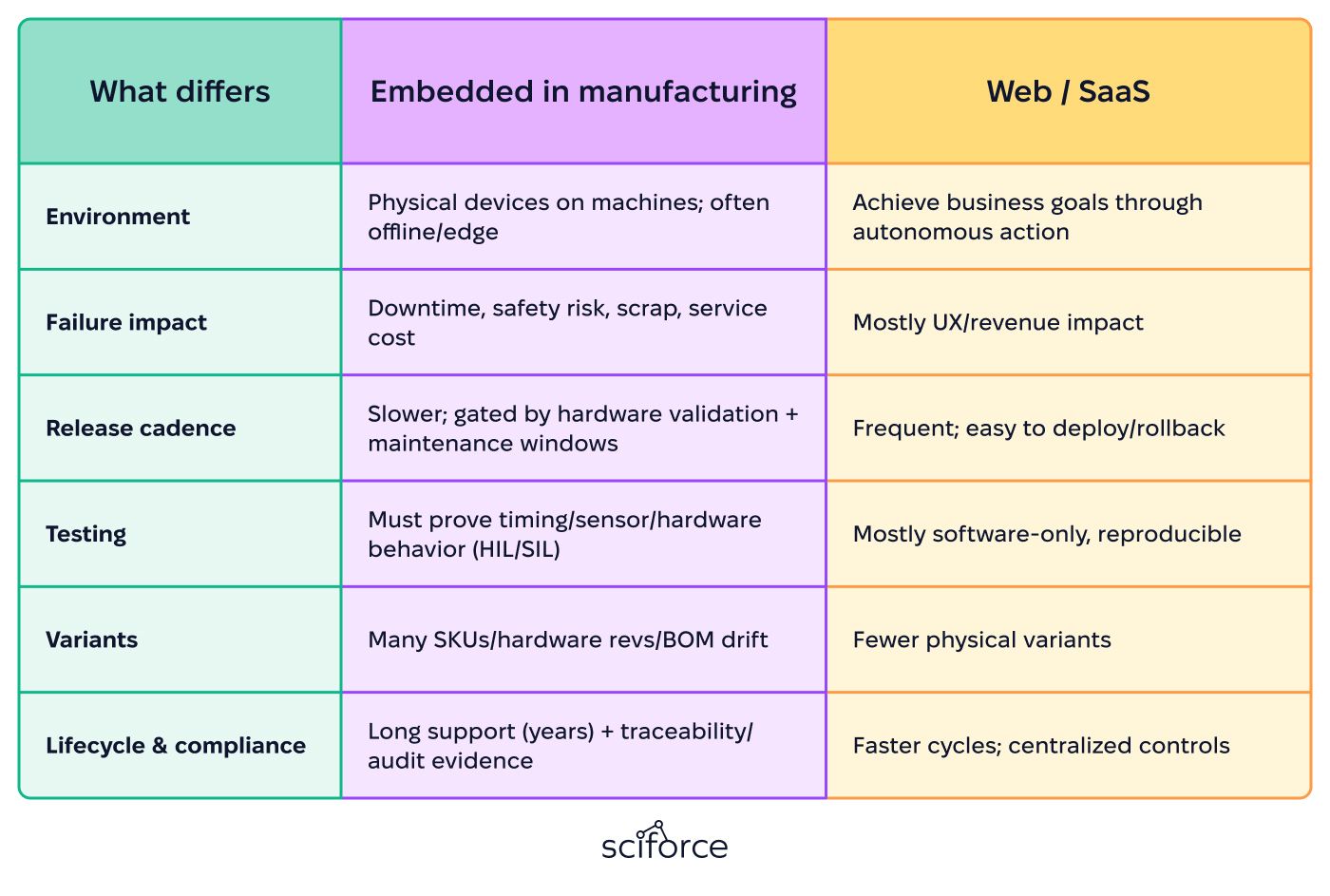
A bad embedded release can stop a line, leave a device dead on boot, or create a safety incident. The software is tied to physical hardware, so validation depends on specific equipment, environmental conditions, and production context that are hard to reproduce.
HIL (hardware-in-the-loop) benches are expensive, limited in number, and hard to scale. Most teams have two or three for an entire product portfolio. That scarcity forces serialised testing, which pushes hardware-related issues late in the cycle, often to final integration, sometimes to the shop floor itself.
Compounding this: reproducing a build from three years ago means finding the exact compiler version, SDK, and hardware revision that existed then. Without disciplined build environment management, that's often impossible. The result is a rebuild that's slightly different from what originally shipped, and with no way to detect it.
A single update may need to run on thousands of machines, each with slightly different hardware. Over a ten-year product lifecycle, a manufacturer might replace a sensor or chip when the original is discontinued. A supplier changes a component without announcement. A customer in Germany runs custom safety logic that conflicts with the standard release. Each of these is a quiet fork in the test matrix, and the matrix compounds faster than any team can validate it manually.
In manufacturing, a software bug is a physical event. Unplanned downtime costs between $10,000 and $500,000 per hour, depending on the industry. At that level, even a short outage gets expensive fast. A bad update can send a specialist on-site to recover the system by hand. That is enough to make every firmware release slow, cautious, and heavily approved.
Patching embedded devices has always been operationally difficult. Now it's also a compliance requirement. Regulators and enterprise customers increasingly require a Software Bill of Materials (SBOM) — a full inventory of every software component inside a device, and expect vulnerabilities to be addressed within defined timeframes. The problem is that the same narrow maintenance windows that make updates risky also make rapid patching nearly impossible. Security and operational stability are pulling in opposite directions, and most embedded teams don't yet have a process that satisfies both.
Development, QA, and operations often work in silos, with manual handoffs and paper approvals replacing automated checks. Nobody clearly owns the basic question of what software is running on which machines in the field, so when something breaks, teams end up tracing versions through spreadsheets, emails, and service notes instead of checking a reliable record. That slows containment and drags out release decisions, because nobody can say with confidence what is running where.
When a field issue surfaces at 2 am, four things determine how fast you can respond: whether you can identify exactly what's running on the affected units, whether you can reproduce the build that shipped to them, whether you have test evidence showing what was validated and on what hardware, and whether there's a clear record of how that release was approved.
Embedded DevOps is the operating model that builds that path covering how a change becomes a signed, traceable release, how it's validated on real hardware, how it reaches the factory floor, and how it rolls out across deployed devices without putting production at risk.
Most embedded release problems trace back to the same two questions: what did we ship, and can we rebuild it exactly? Build integrity is what puts both within reach.
The foundation is repeatable builds: the same code and build inputs producing the same binary regardless of who runs it or where. In practice, that means pinning toolchains, compilers, and SDKs as versioned dependencies, standardizing the build environment (usually containerized), and recording build inputs on every run: repo revision, toolchain version, build flags, feature toggles, target profile. Without this, two engineers running the same build get subtly different outputs and have no way to detect the difference.
Once a build is a release candidate, it needs to be treated as a controlled product rather than a file on someone's laptop. That means:
From there, artifacts move through stages: dev builds for daily work, validation builds backed by hardware test evidence, release builds approved for factory provisioning and field rollout. Only artifacts with the right evidence advance. That gate is what prevents a build that passed unit tests but never touched real hardware from reaching the factory floor.
Hardware-related issues are most costly after a change is already queued for a bench, a factory build, or a site rollout. The layered approach exists for one reason: to catch problems as early as possible and save limited HIL benches for where they're genuinely needed.
Most teams treat the lab as a shared resource — a few benches, booked informally, with results that vary depending on who ran the test. At a scale that stops working. A lab-as-a-service model makes hardware testing consistent and predictable:
Factory integration is a different problem. A factory-ready pipeline provisions device identity, locks in calibration and configuration, and records evidence that enables containment when something goes wrong in the field. Every shipped unit needs a traceable thread connecting it back to its release:
Without that thread, containing a field issue means manually cross-referencing build logs, shipping records, and test results — work that can take days and still leave gaps.
Deploying to thousands of devices in the field is where a bad release does the most damage and where the ability to intervene is most limited. The pipeline doesn't end at the factory floor.
Most rollout failures come from expanding too fast, before there is enough evidence that the update is stable in real conditions. The fix is a staged deployment with hard health gates.
Support also needs structured logs, crash data where feasible, and a diagnostics playbook that works under pressure.
The right amount of process depends on the change. Updating a timing-critical safety path isn’t the same decision as changing a configuration parameter, and treating them the same way is what slows teams down without making releases safer. Test tiers should reflect that, aligned to change impact across per-change, nightly, and pre-release stages.
Security, compliance, and variant management follow the same logic. SBOM generation, signature verification at deployment, and a record of what is running where belong in the pipeline by default. So do explicit versioning rules across SKUs, hardware revisions, and supplier changes, with defined compatibility contracts and support horizons.
A technology company operating large data centers had a recurring issue: a critical pump in the cooling system kept failing without warning. Each failure led to unplanned downtime. Regular inspections didn’t solve it because the team usually discovered the problem only after the pump had already failed.
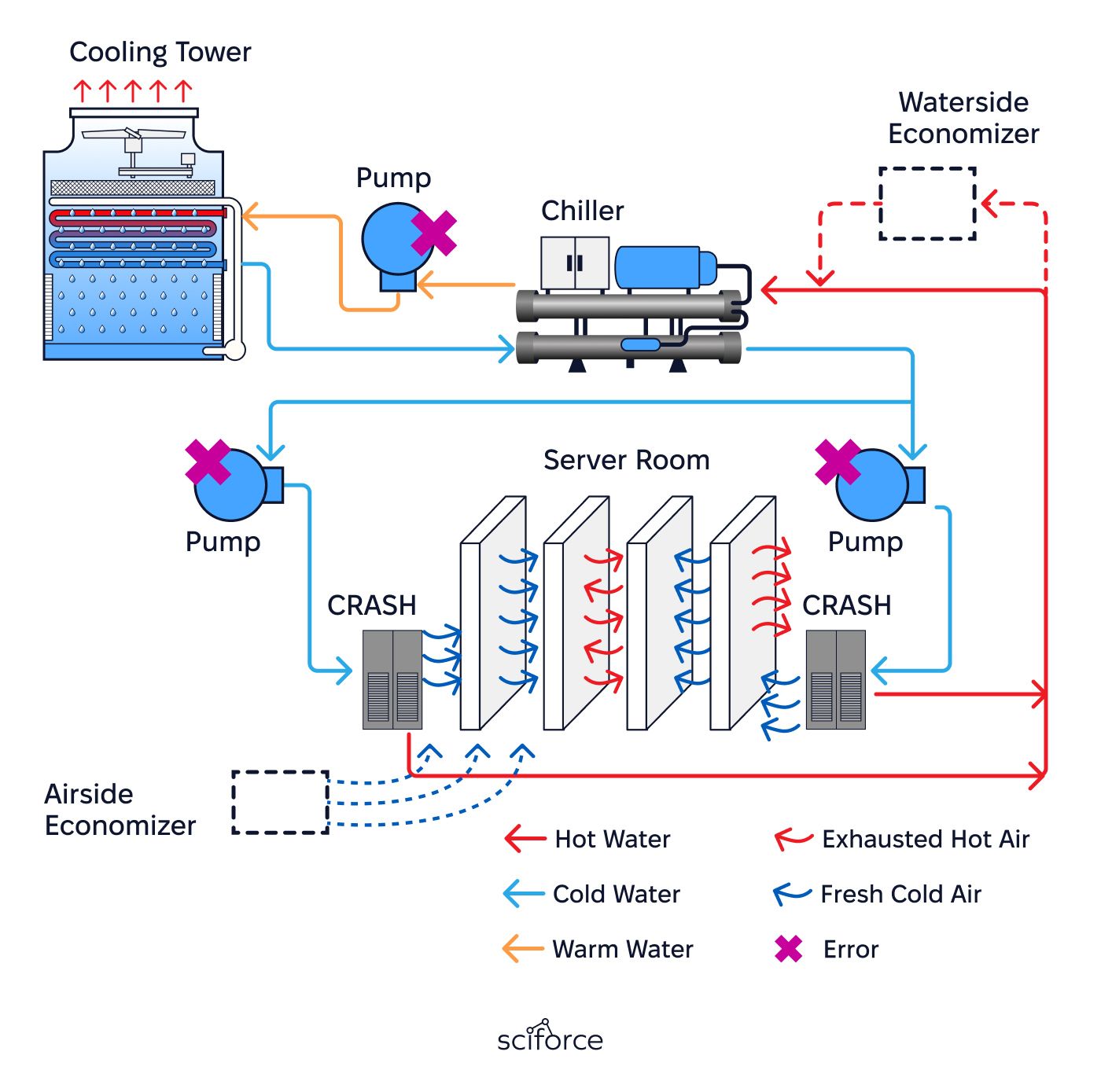
Cooling systems are controlled and monitored through on-site industrial equipment (sensors, controllers, and gateways). The value comes from fast detection close to the equipment and reliable signals that can trigger action before a breakdown – exactly the kind of environment where embedded and edge systems live.
Key constraint: the available sensor data wasn’t labeled with “failure / no failure,” so a standard supervised predictive model couldn’t be trained immediately.
SciForce created a real-time anomaly detection pipeline using data from 100+ sensors (temperature, pressure, flow rate, and other operational readings). To reduce noise and improve reliability, we applied multiple anomaly detection methods (including Isolation Forest, ECOD, and One-Class SVM) and used majority voting: an event was flagged only when most methods agreed.
We then compared detected anomalies with known pump replacement dates and used correlation analysis to identify which sensor patterns appeared consistently before failures. This narrowed monitoring down to four critical sensors and enabled an early-warning system that can be surfaced at the edge (local alerts) and/or forwarded upstream for monitoring and reporting.
Getting anomaly detection right took careful work: 100+ sensors, multiple methods, and majority voting to filter noise. Keeping it right requires an update process that doesn't quietly change what the system does. That's what embedded DevOps is built to protect.
Most firmware update processes run on assumptions — the build matches what shipped, hardware hasn't drifted since the last release. In manufacturing, broken assumptions show up on the floor.
Embedded DevOps puts evidence where the assumptions were. You know what's running, you can rebuild what shipped, and there's a recovery path that's been tested rather than improvised. Firmware updates don't get easier. The risks just stop being surprises.
If that gap sounds familiar, SciForce runs readiness assessments that show exactly where the process breaks down and what it takes to fix it.