AI-powered products can create real value, but only when they continue working reliably in the hands of customers. What makes this difficult is that their behavior doesn’t stay fixed after release. As data changes, so does model performance, which means that quality can decline even when no one touches the code.
According to the 2024 DORA report, elite teams typically deploy on demand (multiple times per day), recover from failed deployments in under an hour, and keep change failure rates around 5%, while low-performing teams often deploy monthly or less and may take weeks to recover from failures. These operational differences have a direct impact on product reliability and user trust
This article looks at what changes when DevOps includes AI, which practices have the biggest impact, and how organizations in healthcare, industry, and consumer environments are already putting these ideas into place.
AI products look like software from the outside, but they don’t behave like normal applications once they’re in production. That’s why a “standard” DevOps pipeline is not enough.
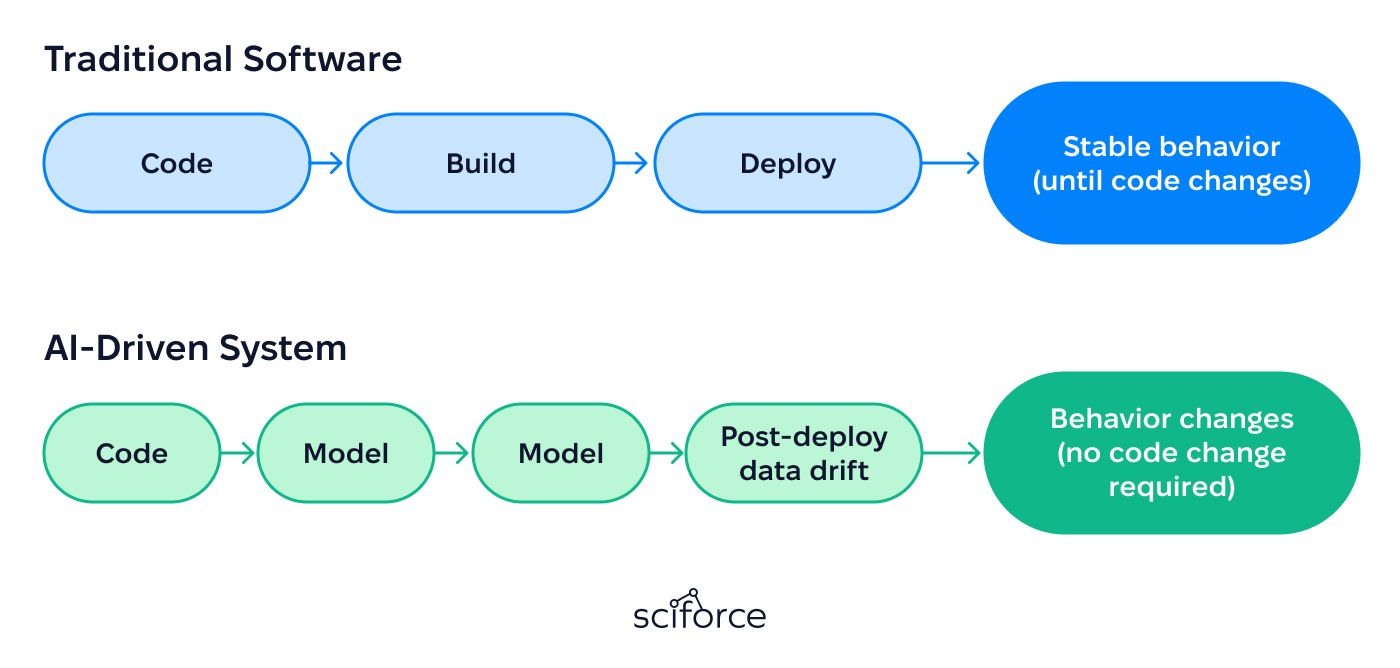
Traditional software behaves consistently unless the code changes. In an AI system, behavior also depends on:
All three can change over time. A model trained on last year’s patterns may start to misclassify events when user behavior, seasonality, or external conditions shift. That means you can ship no code changes and still see quality drop. To manage this, DevOps practices must account for models and data as operational assets – versioned, monitored, validated, and rolled back just as reliably as code. Treating them as static files baked into a deployment image is no longer enough.
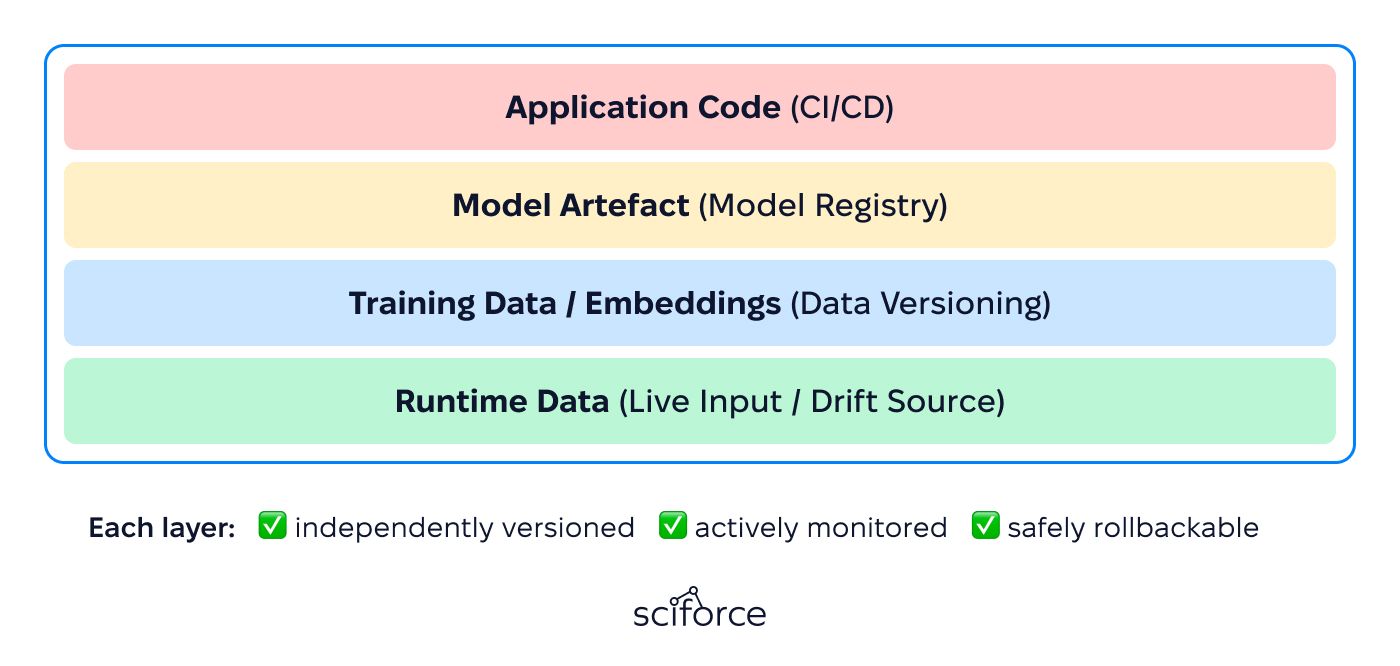
In AI products, performance doesn’t stay fixed after release. Because models rely on changing data, accuracy issues can appear even without a code change. If operational teams can’t detect those shifts or release updated models quickly, product quality declines in the field.
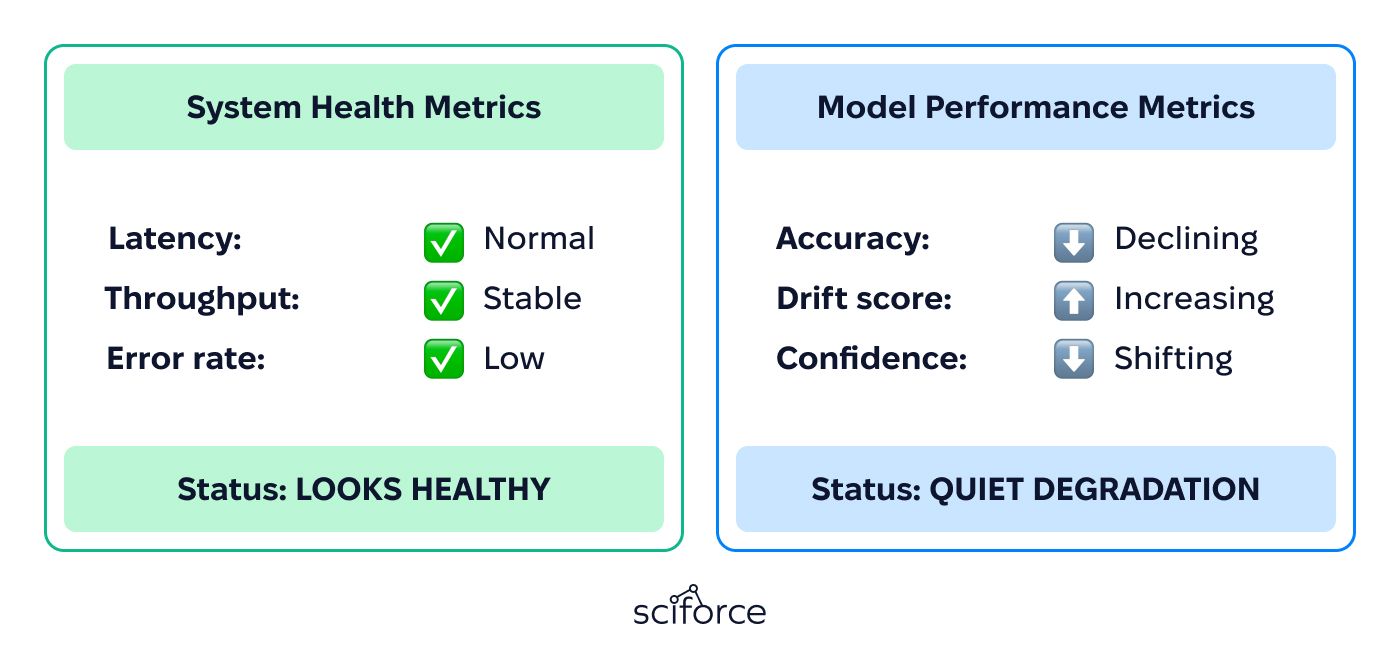
Sustaining reliability means extending DevOps practices to the full model lifecycle:
Keeping AI dependable at scale requires DevOps to manage model performance as actively as application health – with visibility, rapid response, and controlled change as standard practice.
As product behavior increasingly depends on models, update speed becomes a business expectation. Model changes now drive new features and improvements – and they must move through the same reliable delivery pipeline as software.
Distributed environments add further complexity. Smart cameras, medical devices, and industrial systems often have limited compute, inconsistent connectivity, and regulatory constraints. Rolling out a new model version across thousands of devices becomes a coordinated operational task, not an isolated update. At the infrastructure layer beneath that coordination, the multitenant virtual datacenter case shows what fully automated environment lifecycle looks like — Kubernetes clusters provisioned and torn down per tenant without operator involvement, each isolated from the others.
AI accelerates change while raising the cost of failure. DevOps teams need the ability to monitor model behavior, release updates quickly, and recover predictably – across cloud and edge environments. Strong operational discipline is what keeps the intelligence behind the product working as conditions evolve.
AI is increasingly embedded in medical products – from diagnostic support systems to hospital monitoring equipment and wearable sensors. In these environments, each update can influence patient outcomes, so operational processes must guarantee control, transparency, and safety throughout the product’s lifecycle.
DevOps in this domain typically emphasizes:
AI products in healthcare cannot rely on the “deploy and observe” model common in consumer apps. To maintain trust and safety, DevOps must provide continuous improvement without compromising oversight. In medical devices, operational rigor isn’t just efficiency – it’s a regulatory and ethical obligation.
AI is being used in factories and industrial sites to predict equipment failures, improve efficiency, and support worker safety. These systems often run directly on or near the machines they monitor. Hardware resources may be limited, and downtime can be expensive – so updates must be reliable and fast.
A major challenge is that many industrial AI systems run at the edge – close to machines and sensors. Devices may have limited compute, restricted storage, or inconsistent connectivity. As a result, deployment can’t assume a stable network or the ability to update everything at once. DevOps pipelines need to support lightweight model packaging, on-device inference, and rollouts that can tolerate unpredictable conditions.
In practice, teams focus on:
Standard cloud-only DevOps isn’t enough here. Industrial AI requires tooling that supports both cloud and edge environments – with updates that are safe to apply, easy to track, and quick to roll back if needed. The coding copilots article covers how specialized AI assistants are now tuned for ML pipelines, infrastructure generation, and compliance-aware development in 2025.
AI-enabled devices in homes, stores, and public spaces need frequent updates – new recognition models, better detection rules, or security fixes. These updates should install automatically (OTA) and safely across thousands or millions of devices. DevOps teams are responsible for making that happen without interrupting how the devices work day to day.
Most of these products use a mix of edge and cloud processing. The device handles real-time decisions, while the cloud supports analytics and long-term improvements. This creates an operational challenge: both sides must stay in sync as updates roll out.
To support this, DevOps workflows focus on:
Smart devices may look simple to users, but they operate like a large distributed system with many unknowns in the field. Strong DevOps practices are what keep them reliable as they learn and improve.
A multinational hospitality chain with 1,200+ restaurants needed faster, more consistent service across multi-zone dining areas. Staff often missed new guests or tables needing cleaning in less visible zones, which led to delays during peak hours and uneven experiences across locations.
SciForce deployed a real-time computer vision system that tracks the guest journey – from seating to cleanup – using edge processing and POS integration. Because the system supports daily operations, reliability and quick updates were essential.
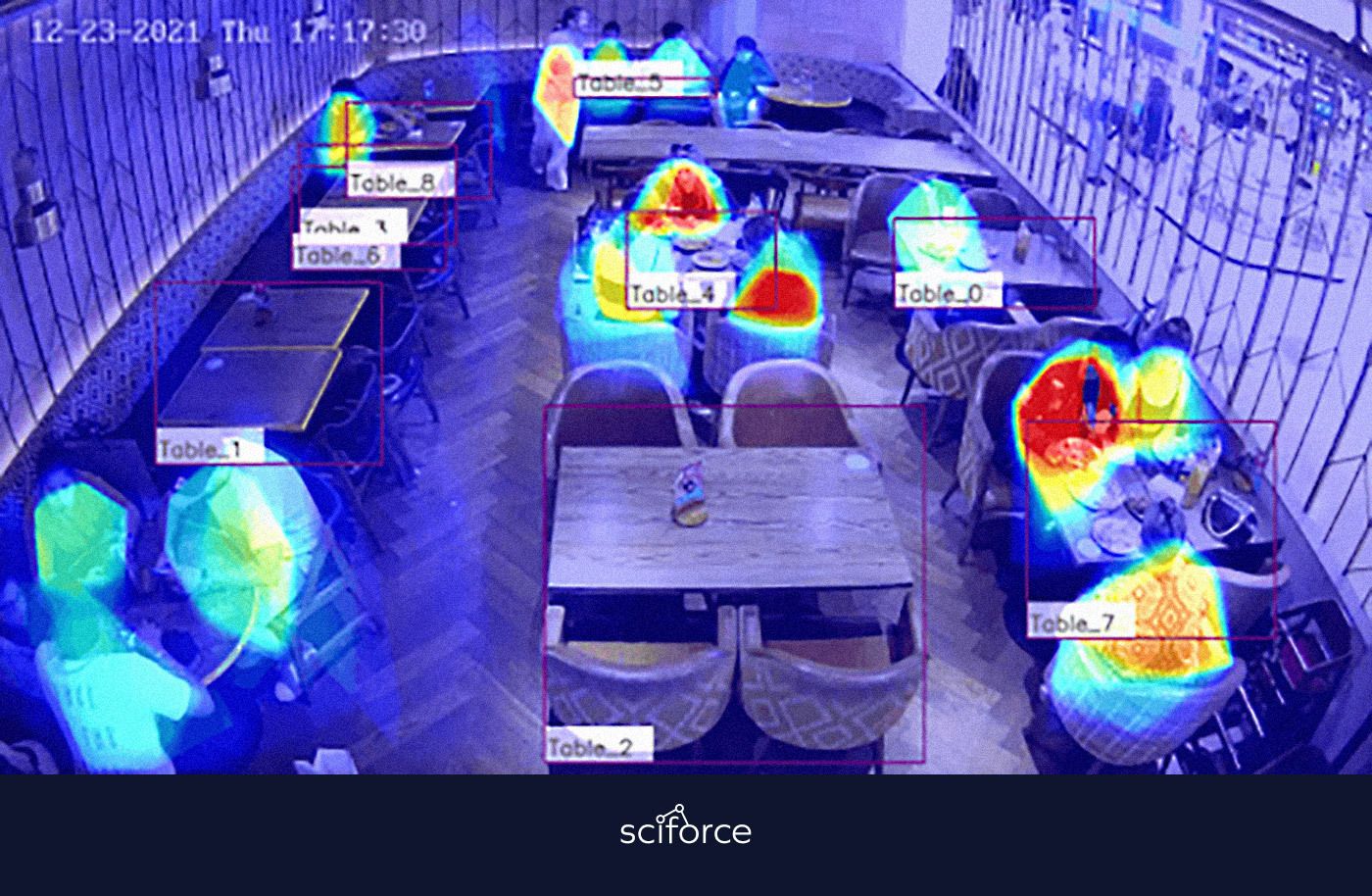
Health and performance monitoring Both system uptime and model behavior are tracked to prevent silent accuracy drops or missed detections.
Central oversight with local continuity Each restaurant keeps running even with limited connectivity, while the cloud coordinates analytics and updates policies.
Standardized rollout templates The same deployment pattern supports rapid expansion to new sites without infrastructure redesign.
The system stayed reliable as it expanded because updates were delivered smoothly, issues were caught early, and improvements went live without slowing down operations.
A medical technology provider needed a faster and more reliable way to extract meaningful concepts from free-text clinical notes. Doctors frequently write shorthand or incomplete phrases, and downstream systems require structured medical terminology. The solution needed to deliver accurate results in real time and remain stable across hospital environments.
SciForce developed a lightweight semantic search service powered by Azure-hosted language models and a locally deployed vector database. The system converts unstructured text into standardized medical codes, supporting terminologies like SNOMED CT and RxNorm. Because this component is used in clinical workflows, updates must be reproducible, traceable, and safe to promote into production.
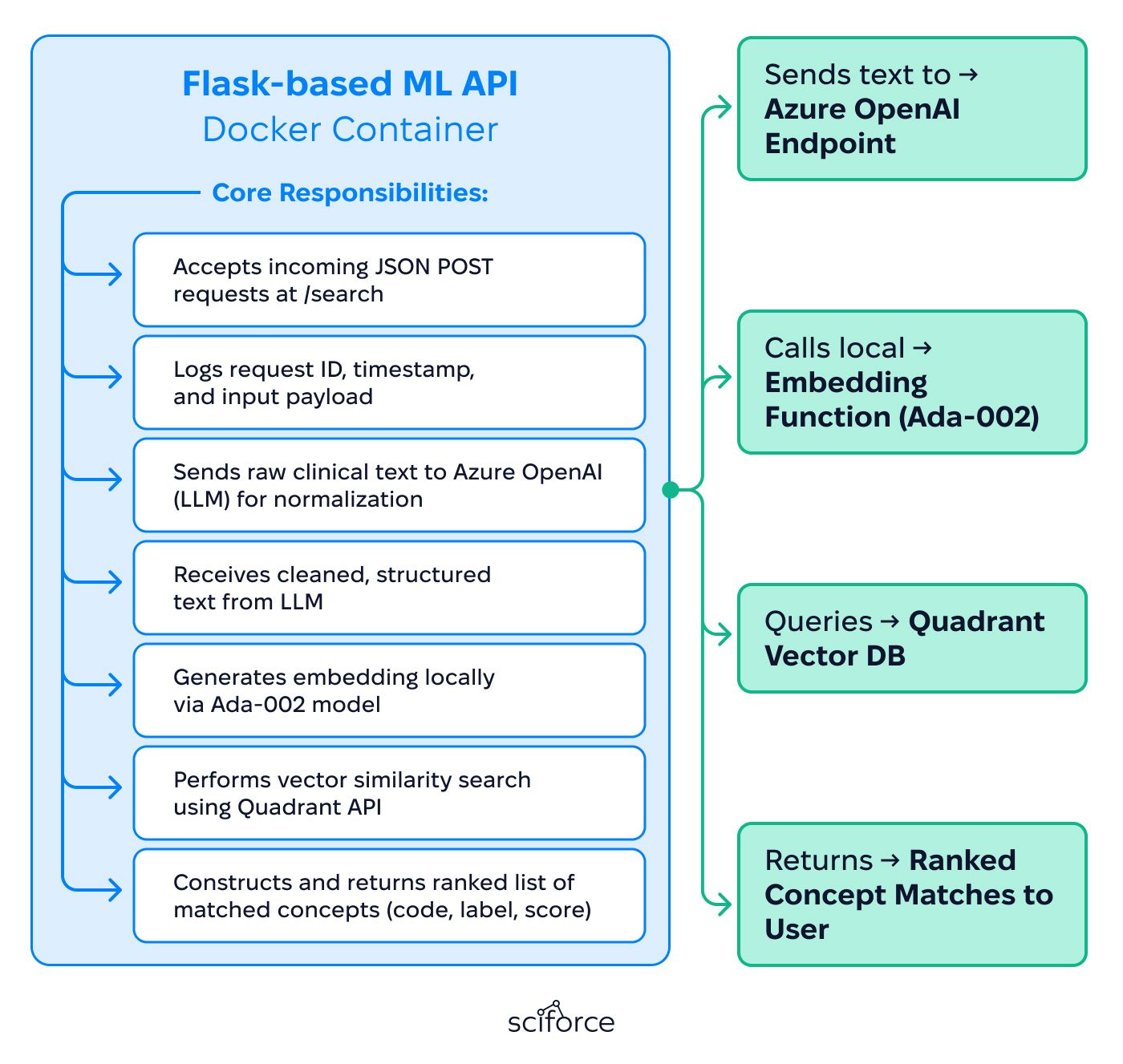
Version-controlled medical knowledge Embedding sets are packaged and deployed like software releases, allowing clean rollbacks and confident updates when terminology changes.
Isolation and modular scaling ML components run in separate containers, so the core platform remains stable even as models evolve.
Environment consistency Containers ensure the exact same behavior across DEV and PROD – critical for clinical decision support.
This project demonstrates how operational discipline enables AI to support clinical workflows where consistency and traceability matter as much as accuracy.
A regional healthcare authority needed a way to forecast infectious disease spread quickly and reliably across multiple administrative districts. Their team managed public health responses for millions of residents, so forecasts had to be accurate and consistent – without requiring developers or data scientists to manually review model updates.
We built a fully automated LSTM-based prediction system designed to ingest new case data every month, retrain, evaluate, and – only when performance improved – promote updated models directly into production. This automation allowed health agencies to rely on continuously refreshed forecasts without operational risk.
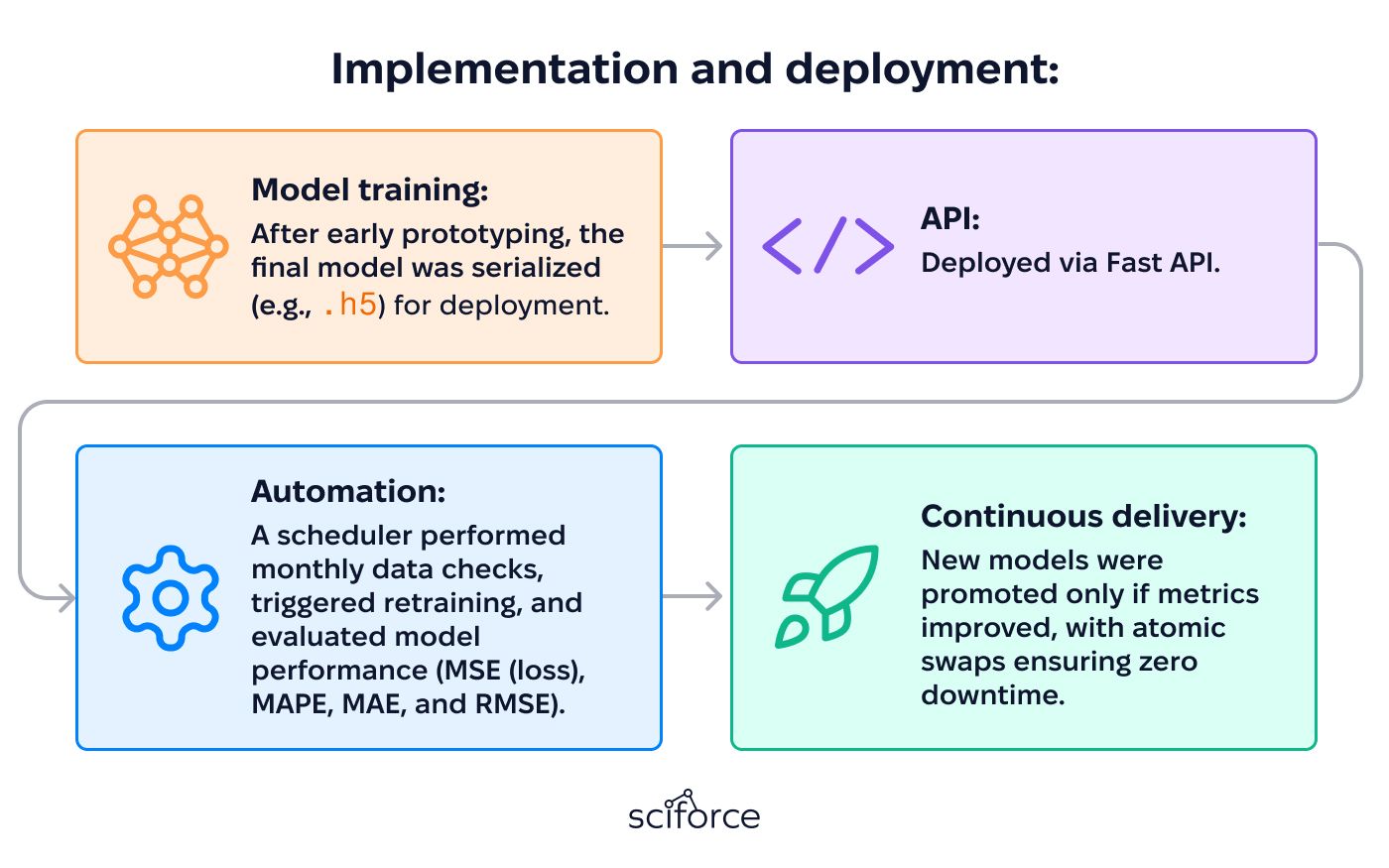
Zero-downtime model promotion Models were swapped atomically via a REST API, keeping live predictions uninterrupted.
Built-in performance gatekeeping Only models that outperformed the current version (MSE, MAPE, MAE, RMSE) were deployed, eliminating silent degradation.
Geospatial intelligence baked into both training and inference The same coordinate mapping logic was shared across pipeline stages, ensuring geographic accuracy for all forecasts.
This combination allowed the organization to operate a continuously improving forecasting system with minimal oversight – while keeping model reliability visible and controllable through metrics, versioning, and audit-ready logs.
AI systems don’t freeze once they go live. As data and real-world conditions shift, their behavior shifts with them, even if the code stays the same. That makes operations a central part of product quality, not just something that happens after release. Teams that watch model performance closely and update models safely can prevent accuracy and user trust from slowly eroding.
If you are building or scaling AI products, book a free consultation to see how strong DevOps and MLOps practices can keep your systems reliable in real-world use.