Walk into a store, grab what you need, and leave – no checkout, no lines. Order room service without touching a phone. Get menu suggestions based on what you actually like, not what’s on special.
This is how AI in retail and hospitality already working behind the scenes.
Retail and HoReCa businesses (hotels, restaurants, catering) are using AI for retail and restaurant operations optimization to improve service speed, operational efficiency, and customer insight. This article looks at how that plays out: the core use cases, the tech that enables them, what the numbers say, and how companies like Amazon, Marriott, and McDonald’s are putting AI to work.
We’ll also share a few of our own AI projects in these sectors – what we’ve learned, where the real value lies, and what’s coming next. Whether you're already testing AI or just considering where it fits, read on to look at what’s working – and what’s worth watching.
What AI Is Doing in Retail and Hospitality
AI for customer experience is being used to reduce wait times, cut repetitive tasks, and help businesses respond faster to client needs. In retail and hospitality, it’s handling routine service requests, recommending products based on actual behavior, adjusting staffing based on demand, and helping managers make better use of available resources.
The sections below break down how this works in practice — what’s being used, why it matters, and what kinds of outcomes businesses are seeing.
Chatbots & Speech Recognition: Customer Service & Guest Interaction
AI chatbots for hotels are handling everything from booking confirmations to late check-out requests, illustrating how conversational AI for customer service in hospitality resolves inquiries in seconds and frees staff for higher-value tasks. For example Marriott’s AI-powered chatbot responds to thousands of guest questions daily across web and mobile, freeing up staff for more complex or personalized service. In many hotels, in-room voice assistants let guests adjust lighting, request towels, or order room service simply by speaking.
The impact is measurable. Hotels using AI-driven service tools report a dramatic drop in response times — from an average of 38 hours down to under 5 minutes. And customers are noticing: 58% of hotel guests say AI improved their overall stay, citing faster support and more seamless interactions.
Whether it's pre-arrival messaging, in-room assistance, or post-stay feedback, AI is quietly but effectively raising the standard for customer interaction across the hospitality and retail sectors.
Personalization & Dynamic Engagement
LLMs Beyond the Hype: 5 Real Business Outcomes You Can Measure Today
Find out more with SciForce free checklist
Using machine learning, NLP, and generative AI, businesses can analyze past purchases, browsing habits, loyalty activity, and location data to enable personalized recommendations using AI in retail and HoReCa, surfacing more relevant offers in real time. This isn't just a nice-to-have – it’s a revenue driver. Personalized product suggestions now account for 31% of total e-commerce revenue, and they consistently lead to higher conversion rates and larger basket sizes.
Starbucks, for instance, uses its app to recommend drinks based on weather, past orders, and time of day — often nudging users toward seasonal or higher-margin items. Meanwhile, McDonald’s, after acquiring Dynamic Yield, implemented dynamic menu boards that shift in real time depending on factors like location, traffic, and trending orders – offering personalized upsells that feel timely rather than random.
For customers, this level of relevance makes experiences feel smoother and more intuitive. For businesses, it’s a way to capture more value from every interaction — without pushing harder, just smarter.
Smart Operations & Revenue Optimization
AI for ROI optimization is also helping with AI-driven demand forecasting and staff scheduling, improving labor planning, replenishment timing, and overall operational efficiency, and AI for business intelligence, allowing businesses to run leaner without sacrificing availability or service quality.
Walmart provides two clear examples. First, it uses an AI chatbot to automate supplier negotiations, leading to streamlined contract adjustments and a 1.5% cost reduction — a notable result at Walmart’s scale. Second, its AI-powered Route Optimization technology helps reduce fuel usage and emissions by generating more efficient delivery paths. This system eliminated 30 million unnecessary miles, avoided 94 million pounds of CO₂, and won Walmart the Franz Edelman Award in 2023. The solution of AI in supply chain optimization is now available as a SaaS offering through Walmart Commerce Technologies, showing how internal innovation can become a platform for others.
Automation & Smart Monitoring
Lumen Technologies provides the infrastructure behind this shift, enabling automation and smart monitoring at scale. They have recently secured $5 billion in new AI-focused networking contracts, and is actively expanding its fiber network with plans to reach 47 million intercity fiber miles by 2028 .
Using AI infrastructure for edge computing, private connectivity, and AI platforms, Lumen supports low-latency use cases like video analytics, AI in inventory management, and dynamic pricing. Computer vision for retail analytics and store optimization is increasingly deployed directly on-site to monitor shelves, analyze foot traffic, and optimize store layouts without relying on cloud latency.
The result: faster service, leaner operations, and more responsive customer experiences, powered by low-latency, high-throughput systems built for AI at scale.
SciForce Case Studies
The big players may dominate headlines, but the real test of AI isn’t scale — it’s adaptability. At SciForce, we’ve worked with clients across retail and hospitality to solve problems that don’t make the press release: chaotic audio at drive-thrus, inconsistent guest requests, menus that change weekly, staff shortages, and split-second service expectations.
In the examples below, you’ll see how we’ve applied custom speech and language models to solve problems where off-the-shelf AI falls short.
Speech Recognition
Speech recognition enables businesses to process spoken language in real time, improving customer interaction and streamlining operations through speech recognition for drive-thru and voice ordering systems and other hands-free service experiences:
Retail: Enables voice-assisted shopping and search, allowing customers to find products, check prices, or manage orders through spoken commands in mobile apps or kiosks.
Hospitality (Hotels): Powers in-room voice assistants for guest requests like adjusting lighting, ordering room service, or requesting housekeeping — reducing the need for calls or apps.
Quick-Service Restaurants: Facilitates voice ordering at drive-thrus or kiosks, helping speed up transactions and reduce queue times during peak hours.
Call Centers & Reservations: Automates routine booking and inquiry calls with speech-to-text AI systems that understand and respond to spoken requests.
Accessibility: Provides voice-based input options for customers who may have difficulty using touch interfaces, improving inclusivity across services.
AI for staff scheduling: Allows hands-free note-taking, status updates, or task confirmations for kitchen and cleaning staff, especially in hygiene-sensitive environments.
Analytics: Uses predictive analytics for retail sales to forecast demand and optimize product availability. Also transcribes and analyzes customer voice interactions to detect sentiment, recurring issues, or compliance gaps, informing service improvements and staff training.
Voice-Driven Ordering: Building a Reliable ASR System for Drive-Thru Chains
A fast-growing AI company developed a voice assistant to automate the order process at Drive-Thru restaurants, replacing the need for human staff at the speaker. The system uses real-time speech recognition to transcribe natural, informal speech — even in noisy outdoor conditions — and sends structured orders directly to the kitchen system.
Key Challenges:
Noisy environments: Background sounds like engines, traffic, and weather interfered with clear audio capture.
Informal speech: Customers used slang, paused mid-sentence, or changed their order on the fly.
Multiple speakers: Overlapping voices and language switching (English ↔ Spanish) required adaptive processing.
Fast-food-specific vocabulary: Menu terms and brand phrases needed custom model training.
Low-latency AI system:: Orders had to be transcribed and processed in under 400ms to maintain conversational flow.
AI-Powered Solution
Voice Activity Detection filters ambient noise and identifies customer intent without wake words.
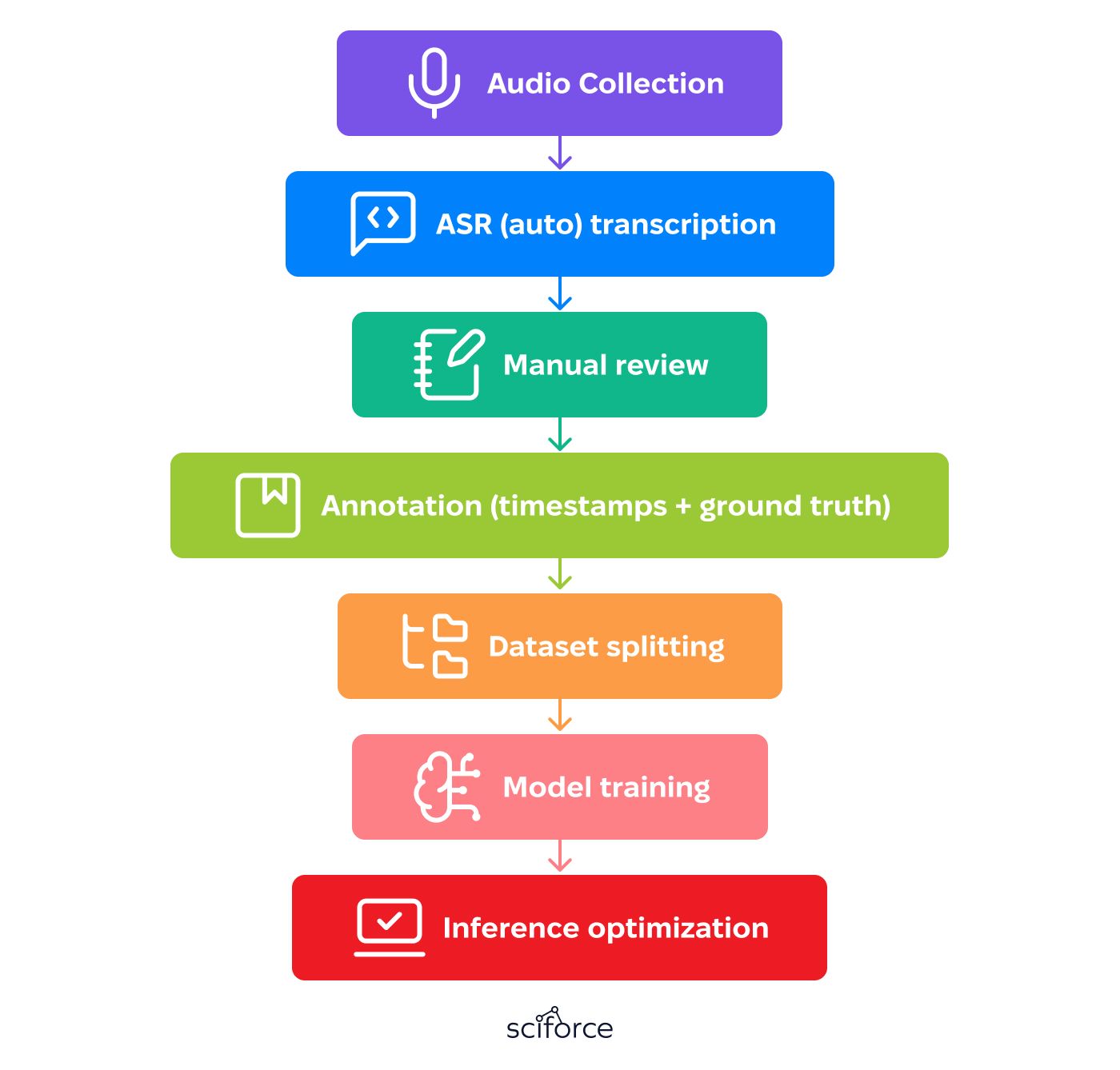
Custom ASR models trained on real Drive-Thru audio accurately transcribe informal, multi-turn orders.
Real-time clarification prompts kick in when confidence is low, improving accuracy without restarting the order.
Multi-language support enables seamless switching between English and Spanish.
Staff voice commands update inventory in real time (e.g., "out of fries"), ensuring order accuracy.
Impact:
Order time reduced by 18–25%, speeding up peak-hour operations
Labor costs lowered by up to 15% through automation at the ordering stage
Average order value increased by 12% through AI-powered upselling and revenue optimization, driven by real-time intent detection and contextual prompts
This solution shows how speech recognition and conversational AI can replace manual order-taking in high-noise, high-speed environments — enhancing speed, accuracy, and customer satisfaction without disrupting kitchen workflows.
Natural Language Processing (NLP)
NLP enables systems to understand and generate human language in written form, supporting smarter AI automation in HoReCa, personalized communication, and data-driven insights across retail and hospitality:
Chatbots & Virtual Assistants: Automates customer support across websites, apps, and messaging platforms by handling FAQs, booking requests, order tracking, and complaints with human-like text responses.
Sentiment Analysis: Analyzes customer reviews, feedback, and survey responses to detect positive, neutral, or negative sentiment — helping businesses prioritize service improvements.
Personalized AI-driven recommendations: Matches users with products, rooms, or services based on past behavior, preferences, and context using NLP-powered recommendation engines.
Smart Search & Product Discovery: Improves search experiences by interpreting customer queries more accurately (e.g., “cheap dinner options near me with outdoor seating”) and returning relevant results.
Automated Content Generation: Creates product descriptions, menu blurbs, and marketing copy tailored to tone, brand, and context using language generation models.
AI for Operational Efficiency: Extracts key themes and trends from large volumes of text data — such as customer reviews, social media mentions, or support transcripts — to inform decision-making.
Multilingual Support: Translates and interprets text-based interactions in real time, allowing businesses to communicate effectively with a global customer base.
NLP Engine for Structured Ordering in Drive-Thru Systems
A Drive-Thru restaurant implemented a domain-specific NLP and NLU (natural language understanding) system to convert unstructured, informal customer language into structured food orders. Built to support complex fast-food menus, the system handles combos, modifiers, promotional items, and multilingual input in real time.
Key Challenges:
Unstructured customer language: Orders like “double burger with extra cheese, no pickles” required interpretation despite slang, pauses, or revisions.
Branded phrasing & synonyms: Phrases like “Mega Cheddar” or “the big meal with fries” had to map correctly to structured POS items.
Combo logic & pricing: The system needed to identify incomplete or misstructured orders and reformat them automatically based on menu rules.
Frequent menu changes: Promotions and limited-time items had to be added quickly without retraining the entire model.
Context across dialogue turns: Customers often revised or added items mid-order, requiring persistent order memory.
NLP-Driven Solution:
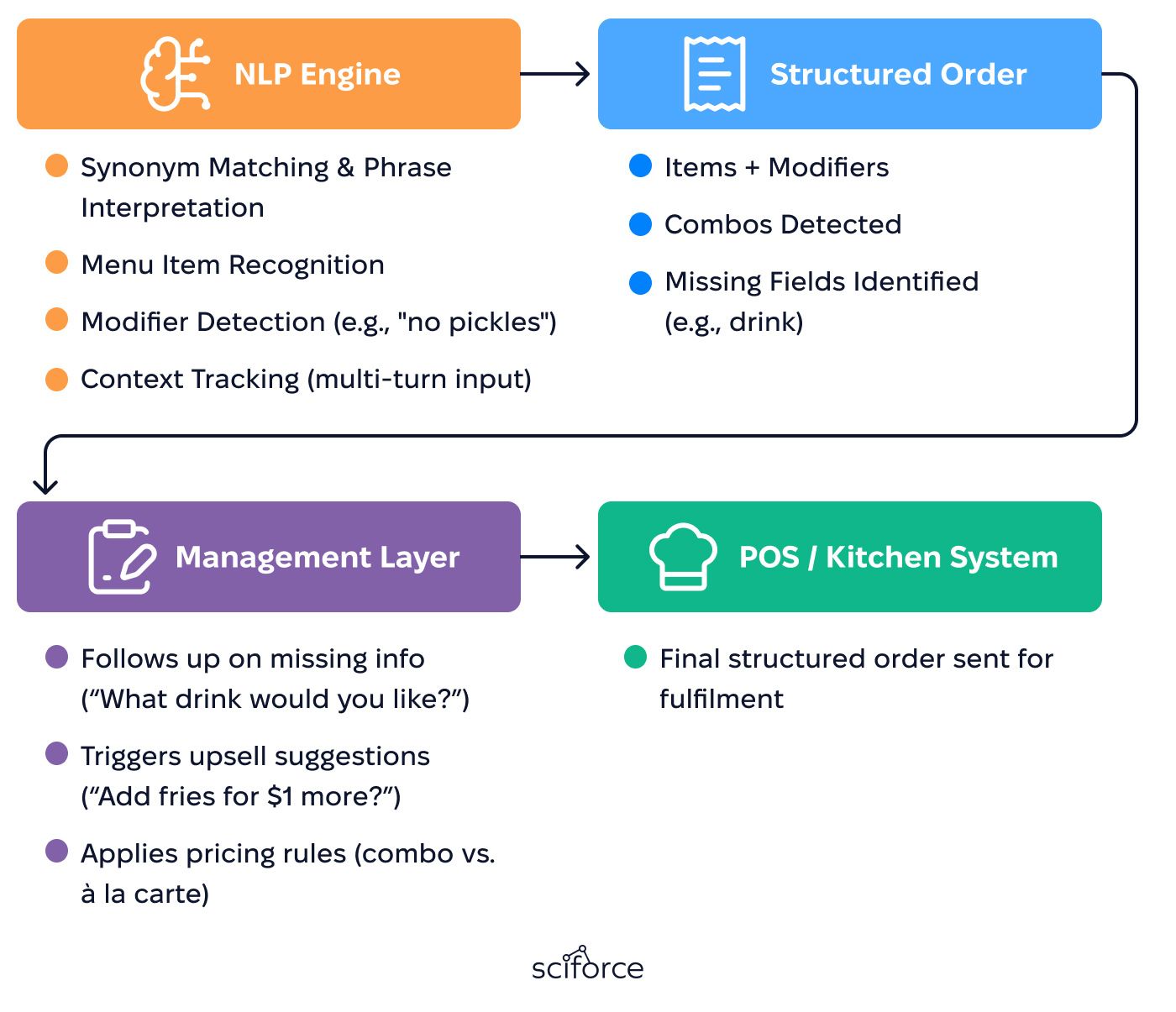
Custom NLP engine parses free-form language into structured order representations (e.g., JSON format), supporting modifiers, dependencies, and bundled pricing.
Menu structuring layer formalizes combo logic, required/optional components, and upsell conditions for accurate parsing and pricing.
Synonym & brand name mapping connects informal or creative phrasing to official item IDs in the menu database.
Multi-turn context tracking enables mid-order changes without loss of prior inputs—ensuring accurate, coherent final orders.
Multilingual understanding auto-detects and processes English or Spanish input, including mixed-language phrasing.
Upselling logic integration suggests combos or add-ons in real time based on intent and incomplete selections.
Impact:
85–88% order structuring accuracy from informal language input
90%+ success recognizing variant phrasing and brand terms
Real-time restructuring of fragmented or out-of-order combos for pricing compliance
Same-day updates for new menu items or promotions
10–12% uplift in average order value via NLP-guided upselling
This solution highlights the strength of NLP in converting messy, casual language into precise, structured data—powering fast, intelligent, and adaptable food ordering workflows at scale.
Computer vision
Computer vision enables businesses to monitor physical spaces in real time, turning existing camera feeds into actionable data on customer behavior, queue dynamics, and service flow — no additional hardware required:
Queue & Crowd Detection: Identifies when queues are forming and alerts staff before wait times become a problem, reducing customer abandonment during peak hours.
Zone-Based Occupancy Tracking: Monitors how customers move through specific areas — entrances, checkout zones, product displays — to reveal traffic patterns and underused space.
Table & Service Cycle Monitoring: Tracks the full guest journey from seating to cleanup, flagging delays in waiter response or table turnover in real time.
Staff Detection & Differentiation: Distinguishes employees from customers using uniform recognition and movement pattern analysis, enabling accurate service event logging.
Heatmap Analytics: Aggregates movement data over time to visualize high-traffic zones, identify bottlenecks, and guide layout or staffing decisions.
Inventory & Shelf Monitoring: Detects empty shelves, misplaced products, or planogram violations automatically, reducing the need for manual stock checks.
Loss Prevention: Flags unusual behavior patterns at self-checkout or high-value product areas, supporting security without constant manual monitoring.
Customer Counting & Footfall Analysis: Tracks how many people enter, exit, and dwell in different areas across the day, supporting demand forecasting and shift planning.
Computer Vision for Restaurant service optimization
A restaurant chain with 1,200+ locations deployed a real-time computer vision system to monitor table status and service cycles across multi-zone dining areas, reducing response delays and improving floor coordination without adding staff.
Key Challenges:
Blind spots: Tables in corners, private sections, and second dining rooms were frequently missed by staff.
No service cycle visibility: There was no automated way to track time from seating through cleanup across all tables.
Manual coordination: Staff had to physically walk the floor to check table status, slowing response during peak hours.
Data gaps: Management lacked shift-level data on waiter response times, table turnover, and peak service periods.
Computer Vision Solution:
YOLO-based object detection maps each table to a predefined camera zone and detects guest and staff presence in real time.
DeepSORT tracking maintains continuous status updates even through occlusions or movement across zones.
POS integration auto-triggers status transitions (e.g., "Waiting for Waiter" → "Waiting for Food") when orders are placed.
Color-coded live dashboard gives staff instant visibility into every table's current state across all dining areas.
Heatmap and zone analytics identify underused areas, recurring bottlenecks, and staffing imbalances over time.
Impact:
Waiter response time dropped from 5+ minutes to under 2 minutes
Table cleanup time reduced from 15 minutes to under 5
Shift scheduling improved through data on peak hours and zone usage
Google rating increased from 4.5 to 4.7 within weeks of rollout
This case shows how zone-based computer vision can replace manual floor monitoring, giving staff real-time awareness and giving management the data to improve service consistency across every location.
Conclusion
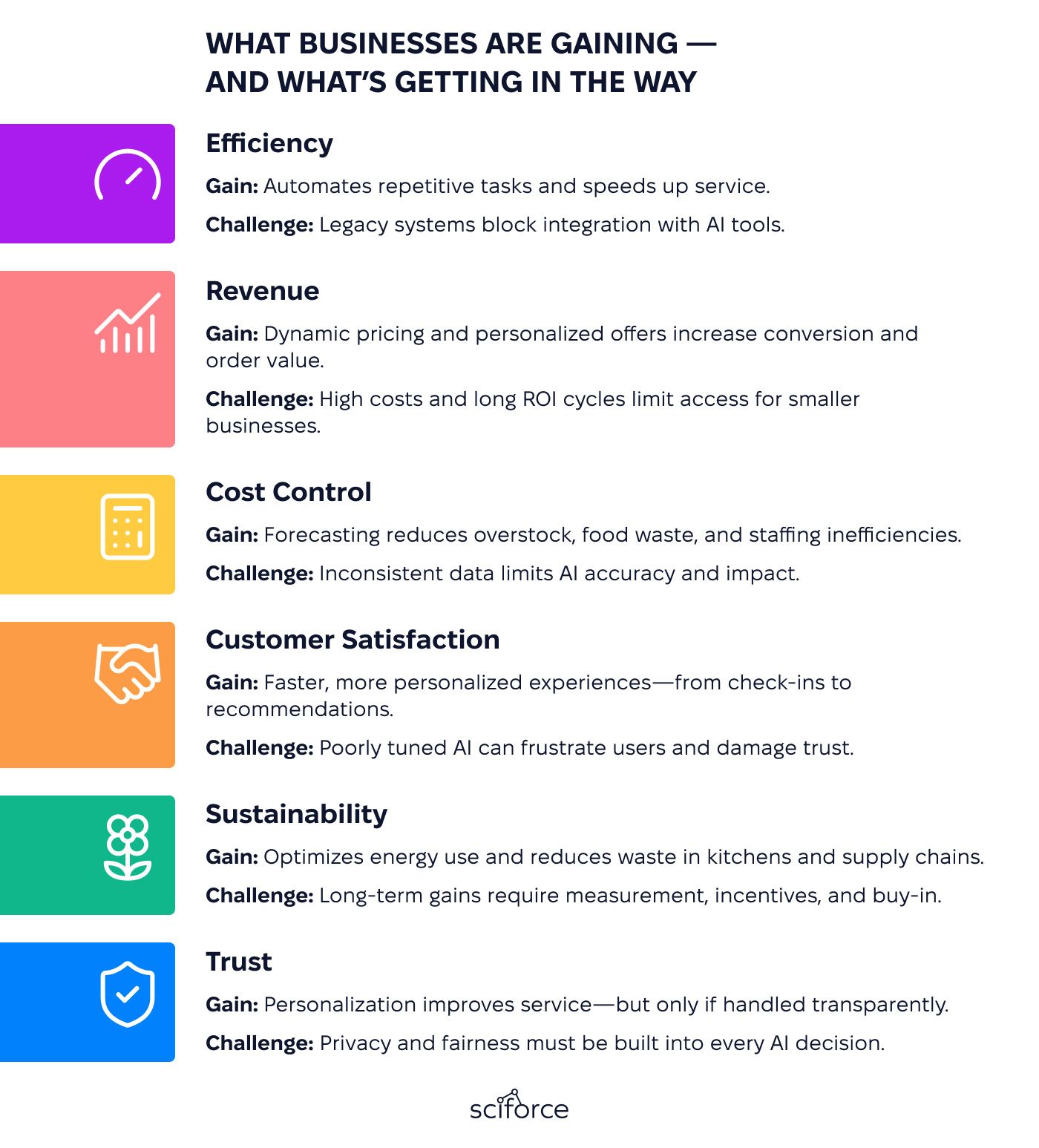
AI is becoming part of the operational backbone for retail and hospitality, helping businesses streamline retail operations, sharpen inventory management, and respond more quickly to real-world demand shifts. The results tend to be measured in practical improvements – shorter wait times, fewer stockouts, more relevant customer interactions.
The businesses moving fastest are those using AI with clear operational goals in mind, not as a showpiece. Challenges around integration, data quality, and ethical use still shape outcomes — but they’re also setting a higher bar for what success really means.
If you're looking at how AI can help you improve specific areas of your business, contact us — we’re here to support you with expert advice.